
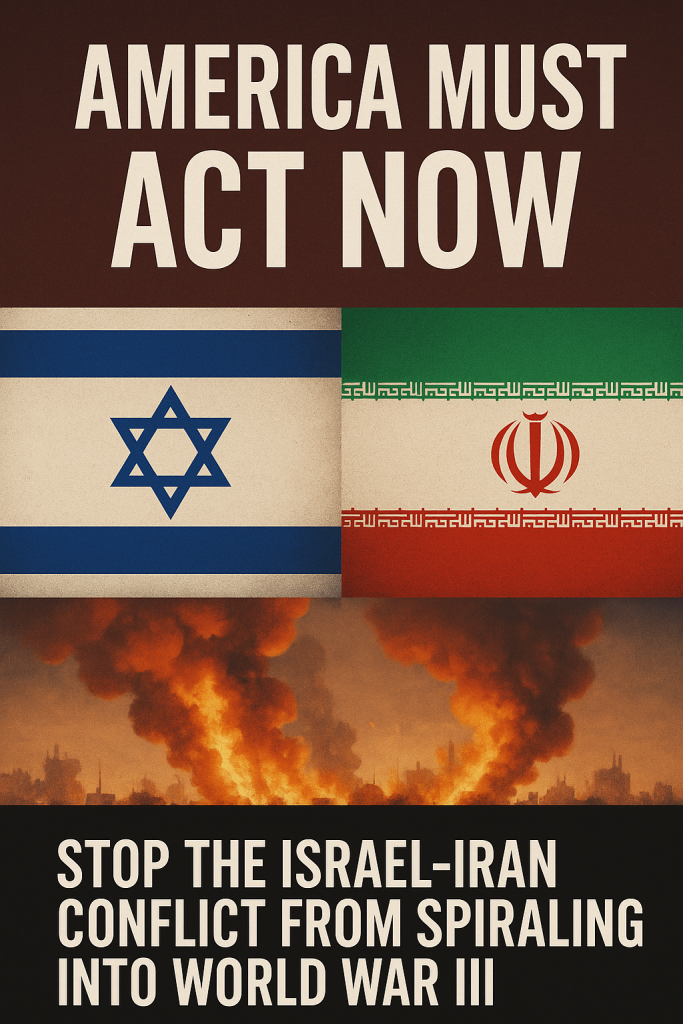
America Must Act Now:
Jun
Stop the Israel-Iran Conflict from Spiraling into World War III
Friday the 13th of June 2025 may go down in history—not for superstition, but as the day the world edged dangerously close to a cataclysm. Israel’s targeted airstrikes on Iranian military infrastructure, and Iran’s swift retaliation, have ignited a fire that could easily consume more than just two nations.
This is not just a regional conflict. This is a global alarm. And unless the United States—and the international community—intervene immediately with wisdom and urgency, the next chapter could be titled World War III.
The Escalation Has Begun
What was once a war of words, proxy attacks, and covert sabotage has now erupted into open military confrontation. In the early hours of Friday, Israeli jets struck key Iranian military assets—allegedly in response to ongoing threats and support for militant proxies. In retaliation, Iran launched a barrage of drones and missiles at Israeli targets.
The world watched in horror.
Markets trembled. Diplomats scrambled. And civilians across both countries huddled in fear, not knowing what the next hour might bring.
This Is a Defining Moment
It’s no exaggeration to say that this could ignite a global war. Iran has allies. So does Israel. Regional players like Hezbollah, the Houthis, and militias in Syria and Iraq could be mobilized. Superpowers like Russia and China, watching closely, could be drawn in depending on how alliances are tested.
The question is not whether this is serious. The question is: Will the United States lead the world away from the brink—or watch it fall?
Why America Must Step In—Now
The U.S. has a responsibility not just as a superpower, but as Israel’s strongest ally and a global voice of diplomacy. Its silence or hesitation could be seen as approval of further violence—or worse, fuel for escalation.
This is the moment for America to:
- Call for an immediate ceasefire and open dialogue.
- Mobilize international actors like the UN Security Council, EU, Turkey, and Qatar to host emergency peace talks.
- Send a clear message that further military actions will be met with diplomatic and economic consequences.
- De-escalate instead of escalating. Strength must be shown in restraint, not just retaliation.
The Consequences of Inaction
Let’s be clear. If this escalates, we are not just talking about more strikes and counterstrikes.
We are talking about:
- Oil prices surging and global markets crashing.
- Millions displaced in the Middle East and beyond.
- A wave of terrorism, hate crimes, and nationalism erupting worldwide.
- The potential for nuclear involvement, either directly or through threatened capabilities.
- An irreversible loss of trust in global diplomacy and institutions.
This is a line we cannot afford to cross.
Wisdom Over War
To all world leaders—wisdom is the need of the hour.
The military option may seem tempting for power shows and political posturing, but history has taught us: wars start easily, but they end in ruins. True strength lies in the courage to pause, to speak, to listen, and to put human life before political ego.
Let America and other leaders not be remembered for fueling a fire, but for stopping an inferno.
What Must Happen Now
- Call for Emergency Talks – The U.S. must urgently lead a summit with Israel, Iran, and other regional stakeholders to cool tensions.
- Activate Peace Proxies – Nations like Oman, Switzerland, and Jordan can act as trusted mediators to facilitate conversation where direct diplomacy fails.
- Uphold International Law – Civilian protection and the prevention of war crimes must be non-negotiable.
- Engage Both Sides with Wisdom – Hold both parties accountable without dehumanizing either side. Peace cannot be built on selective outrage.
This Is Bigger Than Politics
This is about the future of humanity. Whether one supports Israel, Iran, or neither—this is about avoiding a war that will leave no nation untouched. It’s about our children, our economies, our hopes for peace, and our faith in diplomacy.
We stand at a fork in the road. One path leads to deeper destruction, the other to dialogue. Which will we choose?
About the Author
Daniel Elijah Joseph is a global writer, faith-based thinker, and advocate for justice and wisdom in turbulent times. Through his books, blogs, and broadcasts, he champions the cause of peace, divine order, and spiritual awakening in a chaotic world. Visit www.DanielElijahJoseph.com to learn more.
