
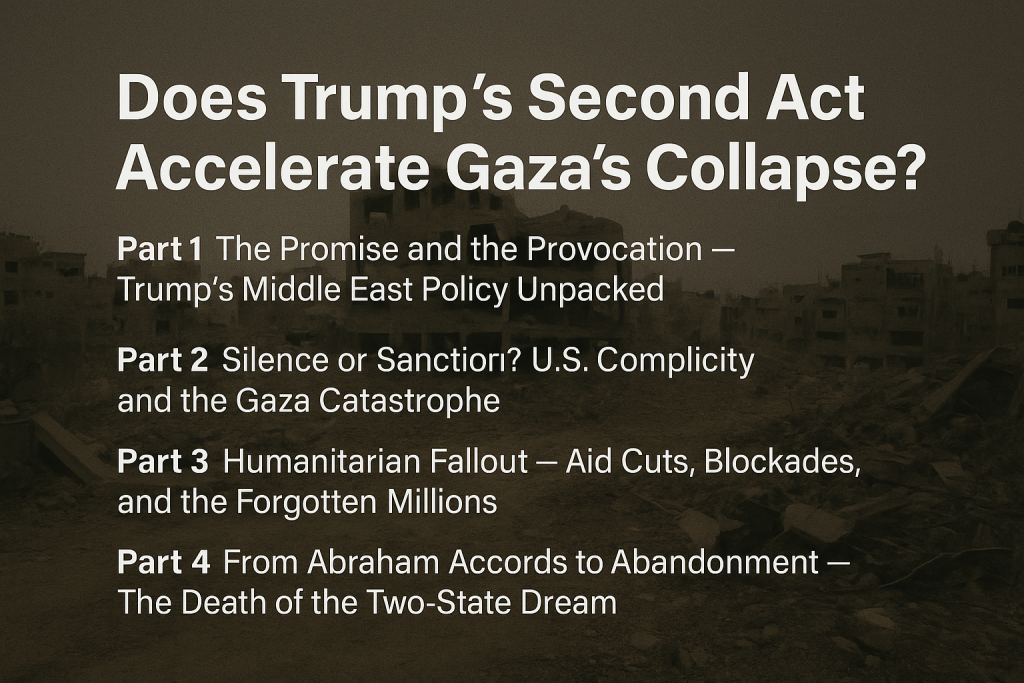
Does Trump’s Second Act Accelerate Gaza’s Collapse? (A 5 part series)
Apr
Part 1: Power Reclaimed — What Trump’s Return Means for the Middle East
From bold promises to deepened divides: How Trump’s second act reshapes the Gaza crisis
When Donald J. Trump returned to the global political stage with renewed vigor in his second term, the world watched with divided anticipation. Supporters saw the comeback of a disruptor who dared to upend diplomatic conventions; critics braced for a fresh wave of unpredictable decisions with global consequences. Nowhere are the stakes higher than in the Middle East — particularly in the battered, besieged territory of Gaza.
Trump’s return is not happening in a vacuum. It comes at a time when the Gaza Strip is in the grip of a devastating humanitarian catastrophe, with tens of thousands dead, infrastructure in ruins, and hope rapidly fading. In such a charged context, every statement, policy, or silence from Washington matters — and Trump’s second-term posture is shaping the crisis in ways both direct and indirect.
This article unpacks the first and foundational question in our 5-part series: What does Trump’s second act mean for Gaza — and the Middle East at large? We examine the signals from his administration, the policy directions emerging, and how his presence emboldens certain actors while silencing others. In a world where leadership matters more than ever, Gaza may be the proving ground — or the graveyard — of Trump’s legacy.
A Return to “America First” — Again
Trump’s “America First” doctrine defined his first term, shifting U.S. foreign policy away from multilateral diplomacy and humanitarian responsibility, and toward transactional, interest-based alliances. His second term picks up where he left off — with a renewed focus on Israeli sovereignty, anti-globalist rhetoric, and a disdain for what he calls “endless wars.”
In early speeches since retaking office, Trump reaffirmed his commitment to standing with Israel, praising the nation’s “unmatched resilience” and calling Hamas a “brutal terrorist regime” that must be “completely eliminated.” While this rhetoric aligns with U.S. policy since 2001, it departs dramatically from calls for proportionality, restraint, or ceasefire negotiations.
For Gaza, this means Washington — under Trump — is unlikely to push for humanitarian access, international mediation, or diplomatic balance. Trump has made it clear: his administration will back Israel without apology, even as reports of mass civilian casualties and destroyed hospitals continue to emerge.
The Echoes of Past Policies
Trump’s second-term posture cannot be separated from the legacy of his first term — a period that radically redefined the U.S.-Palestinian relationship. His recognition of Jerusalem as Israel’s capital, the cutting of over $300 million in aid to Palestinian refugees, and the sidelining of Palestinian leadership in the Abraham Accords all sent a clear message: the U.S. would no longer play the role of neutral arbiter.
That legacy lives on. Palestinian leadership remains fragmented, international trust in U.S. diplomacy is eroded, and Gaza — already blockaded and impoverished — has entered a deeper phase of isolation. Trump’s return does not signal a reversal of these trends. On the contrary, it signals a doubling down.
Most telling is the absence of Gaza or Palestinian rights in Trump’s second-term priorities. His administration speaks frequently of Israeli security but rarely, if ever, acknowledges Palestinian suffering. This erasure is not just symbolic — it informs real policy decisions on arms shipments, vetoes at the U.N. Security Council, and funding to humanitarian agencies.
“Peace Through Strength” — Or Impunity Through Power?
Trump’s defenders argue that his “peace through strength” approach is pragmatic. By backing Israel unequivocally, the theory goes, he deters Iran, strengthens regional stability, and weakens terrorist groups like Hamas. But critics argue this posture enables impunity, allowing powerful states to violate international norms with little consequence.
Under Trump’s watch, the death toll in Gaza has soared. In his second term alone, tens of thousands have died in Israeli airstrikes, including women, children, medical workers, and journalists. Aid convoys are bombed. Hospitals and schools are obliterated. Entire families are erased in the rubble.
Yet, the Trump administration offers little condemnation — only consistent affirmation of Israel’s “right to defend itself.” This phrase, repeated in press briefings and tweets, becomes a shield behind which devastating military operations are justified. It also sends a signal to the world: human rights are negotiable, as long as you’re an ally.
For Palestinians in Gaza, the message is clear — their suffering exists outside the moral framework of Trump’s foreign policy. And for many international observers, this selective empathy signals a dangerous precedent.
The International Fallout
Trump’s return has not only shaped U.S. policy — it has reshaped the entire diplomatic chessboard.
Countries that once relied on U.S. leadership for balancing interests in the region now find themselves recalibrating. European nations, caught between public outrage over Gaza and longstanding alliances with Washington, are splintered in their response. Arab states that signed normalization deals under the Abraham Accords are under pressure from their citizens to speak out — but fear breaking U.S.-brokered alliances.
Meanwhile, China and Russia have seized the opportunity to present themselves as alternative power brokers in the Middle East. Both have criticized Israel’s actions in Gaza and called for ceasefires, positioning themselves as defenders of the global South and the oppressed. Whether sincere or opportunistic, their growing influence is a direct consequence of Washington’s one-sided stance.
Trump’s second term, then, is not just about Gaza — it’s about a shifting world order. And Gaza is the stage on which these global tensions play out in blood and dust.
The Rhetoric of Dehumanization
Another dangerous aspect of Trump’s second-term messaging is the dehumanization of Palestinians in political discourse. While Israeli citizens are described as “innocent victims of terror,” Palestinians are framed monolithically — either as “radical,” “Hamas operatives,” or “human shields.”
This rhetorical framing has real consequences. It justifies disproportionate military action, undercuts humanitarian appeals, and desensitizes the public to civilian suffering. It also fuels Islamophobic narratives that bleed into domestic politics and social media culture.
By refusing to acknowledge Palestinian humanity, Trump’s administration legitimizes policies that violate it. And in doing so, it contributes not just to a crisis — but to a moral collapse of empathy and international conscience.
Voices in the Wilderness
Despite the administration’s hardline stance, dissenting voices persist. Human rights groups like Amnesty International and Human Rights Watch have documented what they call possible war crimes in Gaza. The United Nations has repeatedly called for ceasefires and humanitarian access. Jewish peace activists, Christian leaders, and Muslim scholars across the globe are raising their voices.
But in the Trump White House, these voices are often dismissed as “anti-Israel,” “radical,” or simply “wrong.” This ideological rigidity leaves little room for moral complexity — or meaningful policy shifts.
It also isolates the U.S. on the global stage. Allies are increasingly uncomfortable. U.N. officials are frustrated. And millions of civilians — trapped in the open-air prison that is Gaza — are running out of food, medicine, and time.
Conclusion: Power Reclaimed — At What Cost?
Trump’s return to power has certainly reclaimed dominance in U.S. foreign policy. His administration is once again bold, unapologetic, and unrestrained. But in the Middle East — and especially in Gaza — that power is not perceived as stabilizing. It is seen as inflammatory.
By choosing loyalty to political allies over accountability to human life, Trump has accelerated the conditions of Gaza’s collapse. His second term so far has not led to peace or prosperity. It has led to provocation, polarization, and profound suffering.
As we continue this series, we’ll look at the practical fallout: aid cutoffs, international backlash, the silencing of media, and the slow erosion of a peace process that once held a fragile promise.
In Part 2: “Silence or Sanction? U.S. Complicity and the Gaza Catastrophe,” we’ll dive deeper into the legal, moral, and political implications of America’s stance — and ask the uncomfortable question: Is silence the new sanction?
About the Author
Daniel Elijah Joseph is a spiritual writer, lecturer in Accounting and Finance, and the founder of DanielelijahJoseph.com. With a passion for truth, justice, and divine wisdom, he writes on topics that intersect spirituality, leadership, current affairs, and human dignity. His work challenges mainstream narratives and calls readers to deeper moral and spiritual awareness in a rapidly shifting world.
