
OPEN LETTER TO AMERICA’S TECHNOLOGY LEADERS
Aug
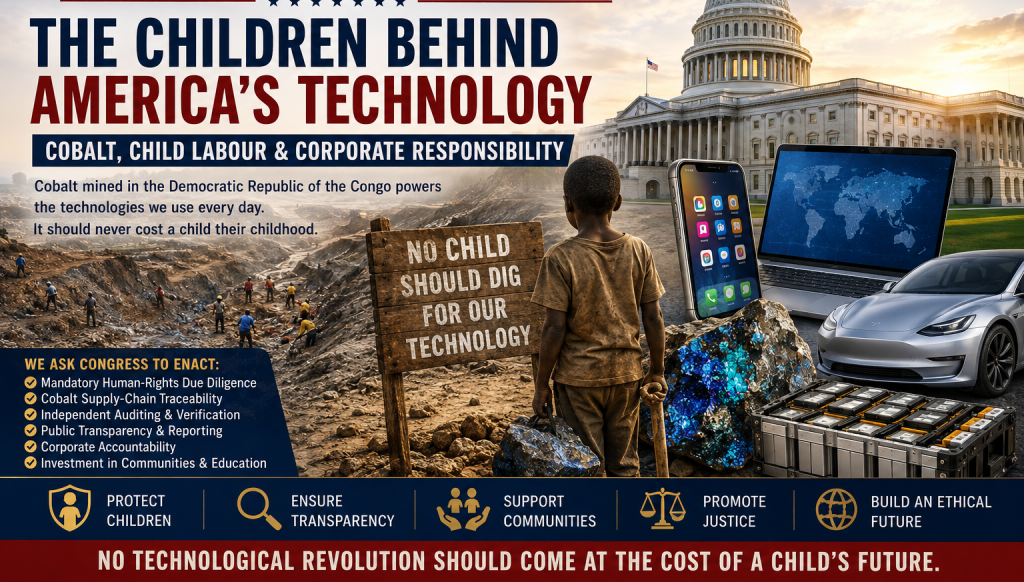
The Children Behind Our Technology
To the Leaders of America’s Technology, Electric Vehicle, Battery and Electronics Industries
Dear Technology Leaders,
The technological revolution has transformed our world.
Smartphones connect billions of people. Computers power education and commerce. Electric vehicles are reshaping transportation. Rechargeable batteries are central to the transition towards a new energy economy.
Behind many of these technologies are critical minerals.
Among them is cobalt.
And at the beginning of parts of the global cobalt supply chain lies an uncomfortable reality:
Children in the Democratic Republic of the Congo continue to perform hazardous work associated with cobalt mining.
This is not simply a problem for Congo.
It is a question for every organisation that benefits from the global technology supply chain.
We Are Not Accusing Technology Companies of Employing Children
Let us be clear.
Major American technology corporations do not necessarily directly employ children working in Congolese mines.
The journey between a cobalt mine and a finished smartphone, laptop, battery or electric vehicle can involve miners, traders, processors, refiners, battery manufacturers, component manufacturers and numerous other intermediaries.
But that complexity raises an important question:
How far should corporate responsibility extend?
We believe the answer is straightforward.
If a corporation benefits from a supply chain, it should make reasonable efforts to understand what happens within that supply chain.
Corporate Social Responsibility Must Reach the Source
America’s technology companies regularly speak about sustainability, responsible sourcing, human rights and Corporate Social Responsibility.
These commitments are welcome.
But CSR should ultimately be judged not simply by policies published on corporate websites, but by measurable outcomes for people.
Responsible technology should mean:
Traceability.
Companies should know, as far as reasonably possible, where their cobalt originates.
Transparency.
Consumers and investors should be able to understand how companies identify and manage human-rights risks within mineral supply chains.
Independent Verification.
High-risk supply chains should be subjected to credible independent scrutiny.
Remediation.
When child labour is discovered, the objective should not merely be removing a supplier from a corporate database.
The underlying problem must be addressed.
And finally:
Community Investment.
The communities producing minerals essential to the technological revolution should participate in the prosperity that revolution creates.
Our Challenge to America’s Technology Leaders
We respectfully invite America’s technology, automotive, battery and electronics industries to make five measurable commitments:
1. Trace the Cobalt
Continue developing systems capable of tracing cobalt through refiners, processors and suppliers towards its source.
2. Independently Verify Supply Chains
Ensure that responsible-sourcing claims can be independently assessed rather than relying exclusively upon internal corporate reporting.
3. Publish the Findings
Tell consumers what risks have been identified, what actions have been taken and what progress remains necessary.
4. Remediate Child Labour
Where child labour is identified, work with credible organisations to remove children safely from hazardous mining while addressing the circumstances that caused them to work there.
5. Invest in Mining Communities
Support education, vocational training, safer adult employment and alternative livelihoods within communities connected to high-risk mineral production.
Do Not Simply Leave the Congo
There is an important distinction at the heart of this campaign.
We are not asking technology companies to leave the Congo.
We are asking them to help ensure that Congo’s children can leave the mines.
Simply abandoning artisanal mining communities could make desperately poor families even poorer.
Responsible sourcing should therefore mean improving conditions—not merely moving sourcing somewhere more convenient.
Children need schools.
Parents need sustainable livelihoods.
Workers need safer conditions.
Communities need opportunities.
And Congo should have the opportunity to benefit fairly from the extraordinary natural resources beneath its soil.
Technology Can Help Solve the Problem
The companies receiving this message include some of the most technologically sophisticated organisations humanity has ever created.
You have developed artificial intelligence.
Global logistics networks.
Satellite systems.
Advanced manufacturing.
Electric vehicles.
Smartphones capable of connecting almost anywhere on Earth.
Surely that same innovation can help create increasingly transparent mineral supply chains.
If technology can track a package across continents until it reaches someone’s front door, human ingenuity can continue improving our ability to trace the minerals contained inside the device used to order that package.
Profitability and Humanity Are Not Opposites
This campaign is not anti-business.
It is not anti-technology.
And it is not anti-profit.
Successful companies create employment, innovation, investment and economic growth.
We want America’s technology companies to prosper.
But the most successful corporations in human history also have the opportunity to establish the highest standards of corporate responsibility in human history.
Profit and principle can coexist.
Innovation and human dignity can coexist.
Technology and ethical responsibility can coexist.
The Question We Ask
To every corporation whose products depend upon cobalt and other critical minerals:
Can you demonstrate that you know where your cobalt comes from?
And where risks of child labour exist:
What are you doing about them?
Those are reasonable questions.
Consumers deserve answers.
Investors deserve answers.
Governments deserve answers.
And most importantly,
the children deserve answers.
A Different Kind of Technology Revolution
Imagine what responsible corporate leadership could achieve.
Imagine technology companies competing not only to produce the fastest device or most advanced vehicle, but also to establish the world’s most ethical supply chains.
Imagine a generation of children leaving dangerous mines and entering classrooms.
Imagine mining communities receiving education, skills, infrastructure and sustainable economic opportunities.
That would be innovation worthy of the name.
Our Invitation
We therefore invite America’s technology leaders to work with governments, international organisations, responsible mining organisations and Congolese communities towards a future based upon:
Responsible Technology.
Ethical Supply Chains.
Transparent Cobalt.
Corporate Accountability.
Community Investment.
Education for Children.
The children of Congo should not remain invisible at the beginning of our technological supply chains.
They deserve education.
They deserve safety.
They deserve opportunity.
They deserve a future.
And they deserve their childhood.
Children Are Not a Component in Our Technology.
We are not asking technology companies to leave the Congo.
We are asking them to help Congo’s children leave the mines.
Respectfully,
Daniel Elijah Joseph
Author | Lecturer | Founder, Daniel Elijah Joseph Publications
United Kingdom
