
OPEN LETTER TO THE UNITED STATES CONGRESS
Aug
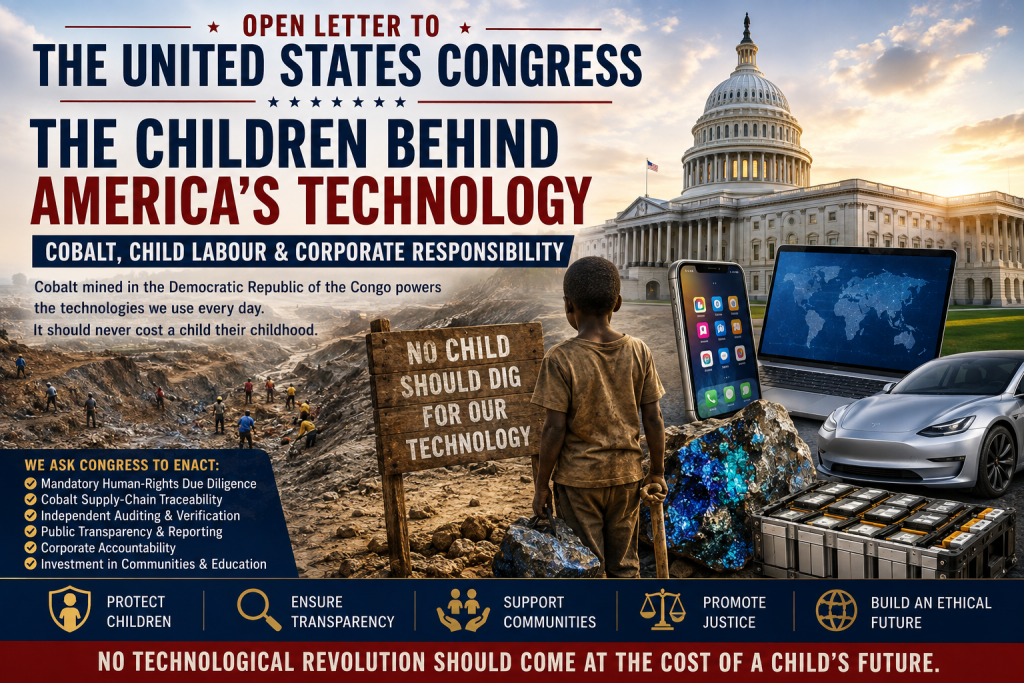
Cobalt, Child Labour and Corporate Responsibility in America’s Technology Supply Chains
To the Members of the United States Senate and House of Representatives
Dear Members of Congress,
I write to urge the United States Congress to examine an uncomfortable reality at the beginning of some of the world’s most valuable technology supply chains:
Children are still involved in dangerous mining activities in the Democratic Republic of the Congo, including the mining of cobalt.
Cobalt is an important mineral used within supply chains supporting rechargeable batteries and technologies including smartphones, laptops, electric vehicles and energy-storage systems.
These technologies represent extraordinary human progress.
But technological progress should never depend upon the exploitation of vulnerable children.
The United States Already Knows There Is a Problem
This is not simply an allegation circulating on social media.
The United States Department of Labor reports that children in the Democratic Republic of the Congo perform dangerous tasks associated with cobalt mining.
These activities can include digging, working underground, carrying heavy loads, crushing, sorting, transporting and washing minerals.
The Department of Labor also includes cobalt ore from the Democratic Republic of the Congo on its List of Goods Produced by Child Labor or Forced Labor.
The evidence therefore raises an important question for Congress:
What responsibility should corporations benefiting from these international supply chains have for conditions at their source?
Technology Companies May Not Employ These Children Directly
We recognise an important distinction.
Major American technology corporations generally do not directly employ children working in Congolese mines.
Between a mine in the Congo and a finished smartphone, laptop, battery or electric vehicle can exist a complicated international network of traders, processors, refiners, manufacturers and suppliers.
But complexity cannot become immunity from responsibility.
If corporations benefit economically from global supply chains, they should have a reasonable obligation to understand those supply chains.
Corporate Social Responsibility should not stop at the factory gate.
It should extend to the source.
We Ask Congress to Act
Congress possesses the power to establish standards capable of transforming corporate behaviour far beyond America’s borders.
I therefore respectfully ask Congress to consider comprehensive legislation establishing meaningful responsibilities for corporations importing, manufacturing or selling products containing cobalt and other high-risk critical minerals.
Such legislation should consider:
1. Mandatory Human-Rights Due Diligence
Large corporations using cobalt should be required to identify, assess, prevent and mitigate credible risks of child labour, forced labour and serious worker exploitation throughout relevant portions of their supply chains.
2. Cobalt Supply-Chain Traceability
Companies should be required to make reasonable efforts to establish where their cobalt originates and document its journey through processors, refiners and manufacturers.
3. Independent Supply-Chain Auditing
Corporate declarations alone are insufficient.
High-risk mineral supply chains should be subject to credible independent verification.
4. Public Transparency
Consumers, investors and policymakers should be able to understand where companies source critical minerals and what measures they are taking to prevent exploitation.
5. Meaningful Corporate Accountability
Where corporations knowingly disregard credible evidence of child labour or forced labour within their supply chains, legislation should provide meaningful consequences.
Corporate Social Responsibility cannot remain meaningful if responsibility is entirely voluntary.
But Please Do Not Simply Abandon Congolese Mining Communities
There is another side to this issue that deserves equal attention.
Congress should avoid creating incentives for corporations simply to abandon artisanal mining communities whenever child labour is discovered.
That could unintentionally deepen poverty.
If families depend upon mining for survival, removing their source of income without providing alternatives may move exploitation somewhere less visible rather than solving it.
Our objective should therefore be larger:
Get children out of mines and into schools.
But also:
Help their families escape the poverty that put those children into mines in the first place.
Legislation should therefore encourage corporate participation in credible remediation programmes involving:
- education and school access;
- vocational training;
- safer employment for adults;
- alternative livelihoods for families;
- formalisation and improvement of artisanal mining;
- worker protection and safety; and
- independent monitoring of mining communities.
Let the Communities Producing the Minerals Share in the Prosperity
The Democratic Republic of the Congo possesses extraordinary natural wealth.
Yet communities sitting above some of the world’s most valuable mineral resources can remain desperately poor.
That contradiction should concern all of us.
The people producing materials essential to the global technological revolution should participate in the prosperity that revolution creates.
This is where Corporate Social Responsibility can become something tangible.
Not simply another sustainability report.
Not simply another corporate pledge.
But schools.
Training.
Safe employment.
Worker protection.
Community investment.
And children given the opportunity to build futures outside dangerous mines.
Innovation and Responsibility Can Coexist
This is not an attack on American technology companies.
America’s technology sector has transformed modern civilisation and continues to produce extraordinary innovation.
We want those companies to succeed.
But leadership carries responsibility.
The companies capable of designing artificial intelligence, advanced smartphones, electric vehicles and some of the world’s most sophisticated supply-chain systems also possess extraordinary technological resources that can help improve traceability and transparency.
If modern technology allows a consumer to track a package travelling thousands of miles to their front door, surely human ingenuity can continue developing systems capable of tracing critical minerals through global supply chains.
Congress Has an Opportunity to Establish a Powerful Principle
The principle is simple:
Those who benefit from a supply chain should take reasonable responsibility for understanding what happens within that supply chain.
American companies should not be expected to solve the Democratic Republic of the Congo’s problems alone.
The Congolese Government has responsibilities.
Mining companies have responsibilities.
International organisations have responsibilities.
Consumers and investors also have roles to play.
But multinational corporations benefiting from these minerals cannot be absent from the conversation.
Children Are Children — Wherever They Are Born
America rightly takes the protection of children seriously.
But human dignity does not end at America’s borders.
A child born in the Democratic Republic of the Congo possesses the same fundamental human value as a child born in New York, California, Texas or Mississippi.
Their childhood should not become an invisible component of a battery.
Their suffering should not become an externality buried somewhere within a corporate supply chain.
And their poverty should not make their lives less important.
Our Request to Congress
We respectfully ask the United States Congress to investigate the relationship between cobalt, child labour and American technology supply chains and consider comprehensive legislation establishing:
Due diligence.
Traceability.
Independent verification.
Transparency.
Remediation.
Corporate accountability.
And critically, investment in the communities from which these minerals originate.
America can lead a global transformation in responsible technology.
Let the next generation of smartphones, computers, electric vehicles and energy technologies represent more than innovation.
Let them represent progress that respects human dignity from the mine to the consumer.
Because ultimately:
No technological revolution should come at the cost of a child’s future.
The children of the Congo deserve more than our sympathy.
They deserve action.
Respectfully,
Daniel Elijah Joseph
Author | Lecturer | Founder, Daniel Elijah Joseph Publications
United Kingdom
