
The Hypocrisy of War: Why Leaders Should Send Their Own Children First.
Mar
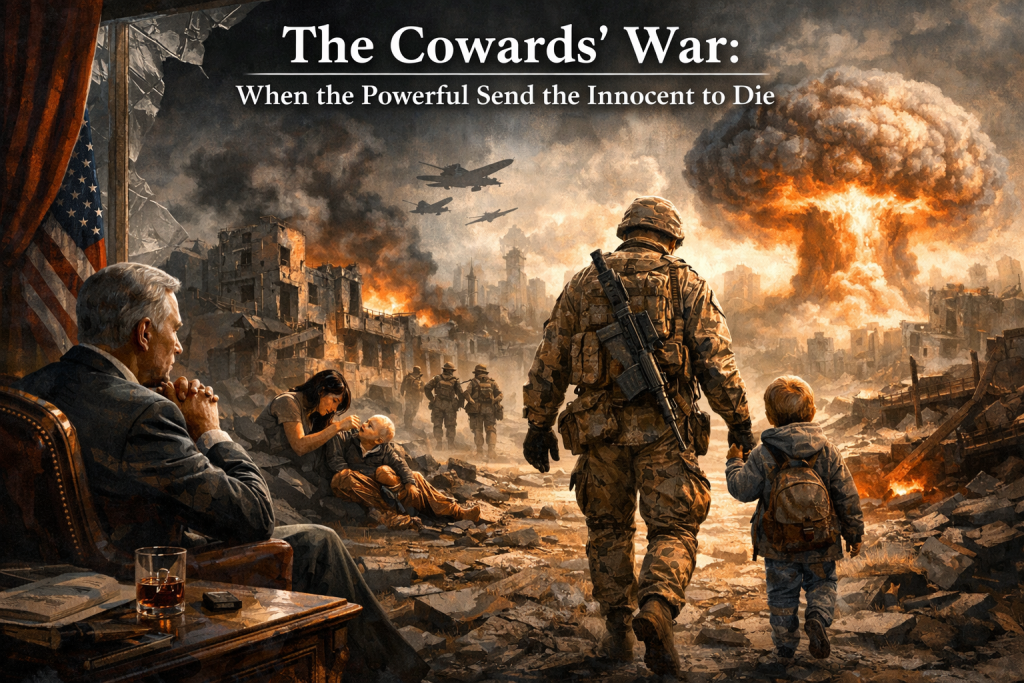
Throughout history, whenever war breaks out, the same tragic pattern unfolds: innocent people die while the architects of conflict remain far from the battlefield.
War is often portrayed as heroic, necessary, or even noble. Governments frame it as a defence of national security, ideological survival, or geopolitical interest. Yet beneath these narratives lies a stark and uncomfortable truth—wars are rarely fought by those who start them.
Instead, they are fought by ordinary people: young soldiers, families caught in crossfire, and civilians who had no voice in the decisions that led to the conflict.
The True Cost of War
When missiles are launched and armies march, it is not the warmongers who pay the ultimate price. It is the innocent.
Children lose parents.
Parents bury their sons and daughters.
Entire communities are destroyed in a matter of hours.
History repeatedly reminds us that the human cost of war is not measured merely in military casualties but in generations traumatized, cities reduced to rubble, and the silent grief carried by survivors.
Those who advocate war often speak in the language of strategy and power. But rarely do they confront the human reality: war is organized suffering.
The Paradox of Nuclear Power
One of the greatest ironies in modern history is the existence of nuclear weapons themselves.
These weapons represent humanity’s most destructive invention—devices capable of annihilating entire cities within minutes. Their destructive capacity is so immense that their use would not only devastate nations but threaten civilization itself.
The world has already witnessed the horrific consequences of nuclear warfare. The suffering caused by atomic bombs demonstrated that such weapons are not merely tools of war but instruments of mass human devastation.
Yet instead of eliminating these weapons entirely, many nations have continued to build, stockpile, and modernize them. Nations claim they maintain nuclear arsenals as a deterrent, but the existence of such weapons also creates a permanent shadow of fear over humanity.
In truth, the only rational long-term solution is clear: no country should possess nuclear weapons. Weapons capable of destroying humanity should have no place in the future of humanity.
War and the Failure of Leadership
War rarely begins because peace was impossible. More often, war begins because communication failed or was never seriously attempted.
The greatest leaders in history were not those who mastered the art of war but those who mastered the art of dialogue, diplomacy, and restraint.
Warmongering often reveals a deeper problem: a lack of wisdom and emotional maturity among those in power.
It is far easier to send armies into battle than to engage in patient negotiation. War can become a shortcut for leaders who lack the skill—or the humility—to resolve conflicts through communication.
True enlightenment requires understanding that violence may win territory, but it rarely wins peace.
A Radical Idea: Shared Responsibility
If societies were truly committed to reducing war, perhaps the rules surrounding it would look very different.
Imagine a world where those advocating military action were required to share the risks they impose on others.
What if political leaders who supported war had to ensure that their own children and grandchildren served on the front lines?
Such a law would change the calculus of conflict almost overnight.
When the personal cost becomes real, decisions become more careful.
It is easy to promote war when the consequences fall on other families. It becomes far more difficult when one’s own family must face the same dangers.
Such a principle would not eliminate conflict entirely, but it would force leaders to think far more deeply before choosing violence.
Humanity’s Choice
Human civilization stands at a crossroads.
We possess extraordinary scientific knowledge, technological power, and economic capability. Yet the same intelligence that built hospitals, satellites, and global communication networks has also created weapons capable of ending our species.
The question facing humanity is simple: will we evolve beyond war, or will we allow war to destroy us?
True progress is not measured by military strength but by the ability to resolve conflict without violence.
A truly advanced civilization does not rely on bombs to settle disputes. It relies on wisdom, dialogue, and compassion.
The Path Forward
Peace requires courage. It requires leaders who value negotiation more than domination and societies that demand accountability from those who govern them.
The greatest victory humanity can achieve is not the defeat of an enemy but the creation of a world where war is no longer necessary.
Until that day arrives, one truth remains undeniable:
Whenever war begins, it is the innocent who suffer first—and suffer most.
And perhaps that is the clearest reason why humanity must do everything in its power to move beyond it.
Daniel concludes that the future of humanity depends not on military strength, but on moral awakening. When leaders learn to communicate rather than dominate, and when societies demand accountability from those who call for war, the cycle of destruction may finally begin to end.
