
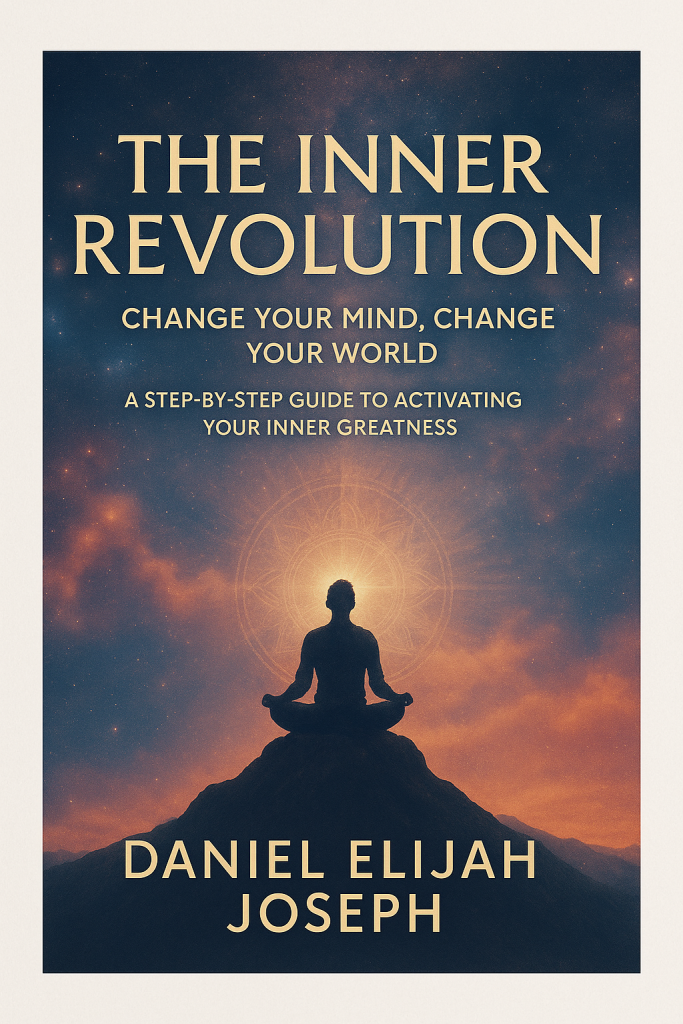
The Inner Revolution: Change Your Mind, Change Your World (Part 2 of 11)
May
A Step-by-Step Guide to Activating Your Inner Greatness.
Chapter 2: Breaking Mental Chains
Identifying Toxic Thoughts and Internalized Limits | Overcoming Doubt, Shame, and Inherited Fear
Before you can fully step into your divine greatness, you must confront what has held you back—not just in behavior, but in belief. The most dangerous prisons are not made of bars, but of thoughts. Mental chains don’t jingle like metal shackles. They whisper like inner critics, masquerading as “truth,” while keeping you bound to a life far beneath your purpose.
Mental bondage is subtle. It doesn’t shout. It hides in your daily choices, in what you believe you can or cannot do, in the silent rules you live by but never questioned. These beliefs often didn’t start with you—but they’ve been living in you, shaping you, and limiting you. And until they’re confronted, they will quietly sabotage every attempt you make to grow, succeed, or heal.
The good news? You can break them.
In this chapter, we will shine light on the toxic thoughts that enslave you, the inherited fears passed down like invisible curses, and the shame and doubt that silence your voice. And then—we’ll dismantle them with truth.
The Unseen Chains: What Are Mental Strongholds?
A mental stronghold is a belief system rooted in fear, falsehood, or pain that governs your thoughts, actions, and identity. It feels normal, but it’s toxic. It feels logical, but it’s a lie.
Think of a stronghold like a fortress in your mind—built brick by brick over time. Each brick might be a painful word someone spoke, a trauma you experienced, a cultural narrative you absorbed, or a repeated failure. Over time, these bricks become a wall. And before you know it, you’re locked inside, unable to see your life beyond the bars of your past.
Some examples of mental strongholds include:
- “I always mess things up.”
- “People like me don’t succeed.”
- “I’ll never be loved the way I need.”
- “I’m not meant for more.”
- “If I fail, it means I am a failure.”
These beliefs feel permanent, but they are not. They are programmable—and therefore, reprogrammable. What has been built can be dismantled. What was internalized can be evicted.
Step 1: Identifying Toxic Thoughts and Internalized Limits
Before we can break free, we must name what’s been chaining us.
Toxic thoughts are recurring mental patterns that drain your energy, suppress your confidence, and distort your sense of identity. They are the thoughts that play in the background like a soundtrack of defeat.
Ask yourself:
- What thought has been quietly stealing my joy?
- What inner voice stops me right before I act?
- What belief do I hold that makes me feel smaller every time I remember it?
Take a moment and write down the most common thoughts that flood your mind when:
- You’re about to take a risk
- You’re alone with your thoughts
- You make a mistake
- You feel rejected or misunderstood
Be honest. This is not about condemnation—it’s about illumination. What you bring into the light can be healed.
Now ask: Where did that thought come from?
Most of our toxic thoughts were not born in adulthood. They were absorbed in childhood, adolescence, or crisis. Many originated from:
- A parent’s harsh words or absence
- Religious guilt or cultural shame
- A teacher’s dismissal
- A painful relationship or betrayal
- Long seasons of silence, where no one affirmed your worth
These moments don’t just hurt—they form. And if not healed, they become internal laws you unconsciously obey.
But here’s the divine truth: you are not the voice in your head.
You are the one listening to it. And now, you get to decide which voices remain.
Step 2: Overcoming Doubt—The Silent Dream-Killer
Doubt is not just a lack of confidence—it’s a spiritual toxin. It sneaks into your inner world, especially after failure or delay, and begins whispering that maybe you’re not good enough. Maybe your dreams were too big. Maybe God forgot about you. Maybe you’re not really chosen.
Doubt causes you to second-guess what you already know.
Doubt makes you revisit what you already healed from.
Doubt tells you to dim your light, just in case you’re wrong.
And the scariest part? Doubt doesn’t destroy dreams immediately. It slowly erodes them through hesitation. You don’t need the enemy to derail you if doubt keeps you stuck at the starting line.
How do you overcome doubt?
- Ground yourself in God’s truth, not your feelings.
Emotions fluctuate. Truth doesn’t. Let your foundation be what heaven says about you—not what your insecurity screams in weak moments. - Act before you feel fully ready.
Doubt often disappears in motion. Confidence is born in doing, not waiting. - Rehearse your wins.
Keep a record of answered prayers, growth moments, and divine encounters. Let your history remind you that you are not starting from zero—you’re building on grace.
Step 3: Dismantling Shame—The Identity Hijacker
Shame is different from guilt. Guilt says, “I did something wrong.”
Shame says, “I am something wrong.”
Shame doesn’t just attack your choices—it attacks your identity. It makes you feel fundamentally flawed, unworthy, broken, or defective. And because shame thrives in secrecy, it often hides in your habits, relationships, or silence.
Shame says:
- “If people really knew me, they wouldn’t love me.”
- “I’ll never be enough for the life I want.”
- “I deserve to settle, because of what I’ve done.”
But shame is a liar. And it must be silenced.
The truth is, shame can only live where healing hasn’t entered. And healing begins with truth-telling and truth-receiving.
Here’s how to break shame:
- Expose it. Tell the truth—to yourself, to God, to a trusted guide. Shame loses power when it is spoken out loud.
- Receive grace. Stop rehearsing what God has already forgiven. You are not your worst moment. You are not your past mistake. You are redeemed.
- Rebuild your self-image. Who you are in Christ is your true identity. Speak it. Live it. Reflect it in your choices.
Step 4: Breaking Inherited Fear—You Are Not Bound by Their Chains
Some of the limitations you carry didn’t start with you. They were passed down—through family, culture, trauma, or religion. This is inherited fear, and it feels like a curse because it operates like one.
Examples of inherited fear:
- “Don’t trust anyone outside the family.”
- “Money is dangerous.”
- “You have to work twice as hard to be accepted.”
- “Success is for them, not us.”
- “If you shine too brightly, you’ll be attacked.”
These aren’t just random ideas. They were survival codes in someone else’s broken world—and now they’ve been passed to you. But you don’t have to carry them. You are the interruption.
You were born into a lineage, but you are not its prisoner. You are the one chosen to break patterns, birth healing, and build legacy. The curse may run in your family—but so does the call.
To break inherited fear:
- Identify the pattern. Name the fear. Trace it to its root. When did you first hear it? Who lived by it?
- Declare your freedom. Renounce every belief that doesn’t align with truth. Speak life over your lineage.
- Start new cycles. Fear is passed down through repetition. Break it with new habits, new declarations, and new spiritual disciplines.
What Replaces the Chains?
You were never meant to live with a blank mind. When chains break, truth must fill the space.
Here’s what you must begin to believe—deeply, daily, and unapologetically:
- I am not what happened to me. I am what I choose to become.
- I am not a mistake. I am a divine masterpiece in progress.
- I don’t have to earn love—I am already deeply loved.
- I was born to rise. My past is a setup, not a sentence.
- The limits I believed are not the truth of who I am.
Affirm these. Pray these. Live these. Let your life speak them.
Conclusion: From Mental Prisoner to Mindful Warrior
Breaking mental chains isn’t easy—but it is essential. Because the life you long for will not be built on broken foundations. You must rise with a renewed mind, not a recycled story.
You are not your thoughts—you are the thinker. You are not your fear—you are the one faith is calling. And you are not your family’s failures—you are your future’s foundation.
Let the inner revolution continue.
Break the chains.
Choose the truth.
Rewire your mind.
And rise into the life you were born to live.
About the Author
Daniel Elijah Joseph is a spiritual teacher, writer, and transformational thought leader dedicated to helping people reclaim their divine identity, unlock inner power, and live with purpose and impact. With a voice that blends divine wisdom, psychological insight, and practical clarity, Daniel speaks to the soul of those who know they were born for more—but have been stuck in cycles of fear, confusion, or limitation.
A lifelong student of both Scripture and the human soul, Daniel’s teachings flow from a place of deep spiritual conviction, personal experience, and compassionate truth. He believes that inner greatness is not something we earn—it’s something we remember, activate, and embody. His work helps readers do just that: turn inward, connect with God’s voice, and rise into alignment with their divine design.
Through books, devotionals, blogs, and empowerment resources, Daniel challenges conventional thinking and invites others into a deeper, more powerful way of living—centered on faith, discipline, love, and divine clarity.
When he’s not writing or teaching, Daniel is mentoring individuals on their spiritual journeys, writing poetry, building tools of faith, and pouring into his mission of raising up a generation that leads from the inside out.
The Inner Revolution is more than a book—it’s a movement. And Daniel Elijah Joseph is a guide you can trust for the journey.
