
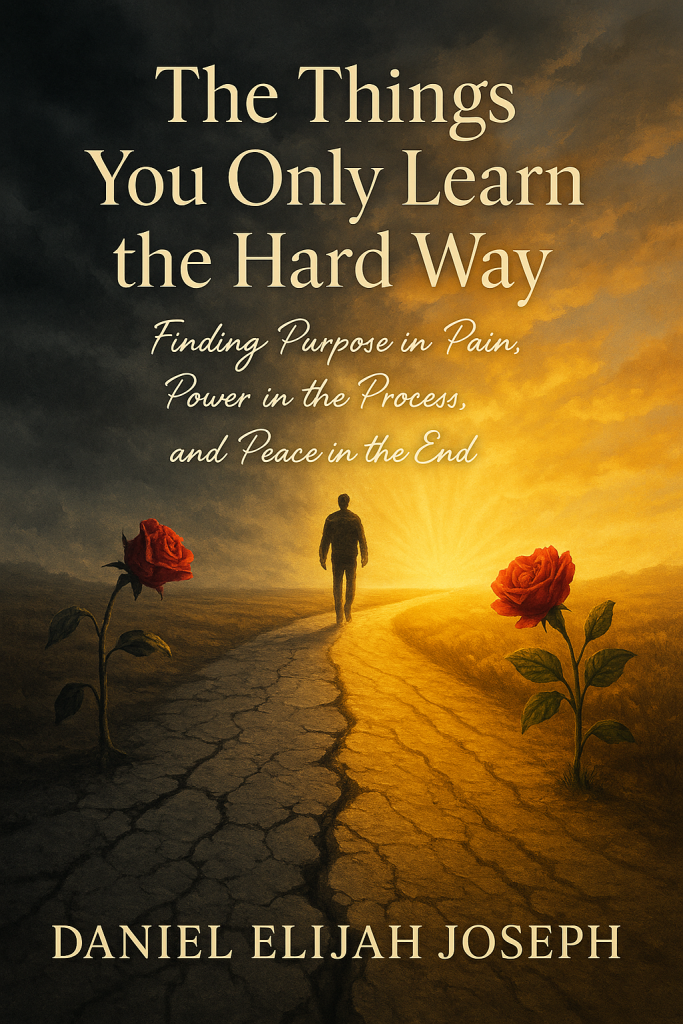
The Things You Only Learn the Hard Way. (Part 1 of 11)
May
Finding Purpose in Pain, Power in the Process, and Peace in the End
Chapter 1 – The Blow You Didn’t See Coming
Part I – The Cracking: When Life Breaks You Open
Sometimes it happens overnight. Other times, it creeps in slowly like a fog, unnoticed until you’re already lost in it. Either way, there’s a moment in every life when you take a hit so unexpected, so destabilizing, that it changes you forever. You’re going about your day—loving, building, trusting—and then, suddenly, everything shifts. The rug is pulled. The storm arrives. And just like that… nothing is the same again.
We call it a “blow” because that’s exactly how it feels—like being punched by life. No warning. No time to brace. Just impact. Shock. Disorientation. And pain. Sometimes it comes through a phone call you never saw coming. Other times, it’s the quiet unraveling of something you thought would last forever—a relationship, a dream, a season, or a belief system. Regardless of its form, one thing is certain:
It breaks you open.
This is the chapter nobody volunteers for but everyone faces. It’s the season that rewrites your identity, whether you want it to or not. And though you may not see it at first, the blow is not just meant to crush you—it’s meant to wake you up.
The Moment Everything Shattered
I still remember one of my own moments vividly. A betrayal that came from someone I loved deeply. There was no warning, only whispers of intuition I had ignored in the name of loyalty and love. I had given my best—my time, my trust, my heart—and yet what I received was deceit and abandonment.
It didn’t just hurt. It confused me.
Because like many soft-hearted souls, I assumed that if I loved purely, I’d be treated purely. If I meant no harm, I’d receive no harm. But life doesn’t always work that way. And in the moments where the pain defies logic, you are left asking questions that echo into the hollow places of your soul:
How could this happen? Why didn’t I see it? Was it all a lie? What am I supposed to do now?
These aren’t just emotional questions—they are spiritual ones. Because when your life fractures, so does your frame of reference. You begin to question not only others, but yourself. Your judgment. Your worth. Even God.
And it is in these spaces—these cracks—that the deeper work begins.
Cracked Open by God
One of the hardest truths I’ve had to learn is this: God allows what He doesn’t always explain. He doesn’t shield us from every betrayal, rejection, or heartbreak—not because He is cruel, but because He sees what we can’t. He sees who we will become on the other side of the breaking. He sees the strength, the discernment, the purpose that pain will extract from us if we let it.
The Bible says in Psalm 34:18, “The Lord is close to the brokenhearted and saves those who are crushed in spirit.” But what it doesn’t say is that God always prevents the crushing in the first place. No, sometimes He allows the blow because the crushing will produce oil. The oil of wisdom. The oil of anointing. The oil of clarity.
Like an olive must be pressed to release its oil, so must we be pressed to release what’s hidden inside us.
So if you’ve been hit by something that knocked the breath out of you—take heart. The fact that it caught you off guard does not mean it caught God off guard. The pain that shocked you was not a surprise in Heaven. It may have broken your heart, but it is building your spirit. The blow was not the end of your story; it was the beginning of a deeper one.
Denial vs. Surrender
When we’re first hit by life, the most common reaction is denial. We want to rewind the clock. Fix it. Understand it. We obsess over what we could’ve done differently, who we could’ve trusted less, what signs we missed. But denial only delays healing. Trying to mentally “make sense” of a spiritual breaking will always leave you frustrated. Some blows aren’t meant to be dissected—they’re meant to be surrendered to.
What does surrender look like?
It looks like breathing through the pain instead of running from it.
It looks like sitting in the silence even when you feel forgotten.
It looks like saying, “God, I don’t understand this… but I’m still here. Use this somehow.”
Surrender doesn’t mean you’re okay with what happened—it means you’re giving it to God because you know you can’t carry it alone. It means you’re trusting that something redemptive will rise from the ruins, even if you can’t see it yet.
Surrender is not weakness—it’s alignment.
It says, “Let Thy will be done… even here. Even in this.”
The Shattering Is Strategic
Here’s what I wish someone had told me when I was going through my darkest blow: This breaking is not random. It’s sacred. In fact, many times, it is the only way God can shift your life when you’ve settled in a place that is too small for your purpose.
Sometimes, we’re too loyal to what’s familiar. Too patient with what’s poisonous. Too faithful to what’s no longer fruitful. And so, because God loves us too much to let us rot in comfort, He allows a blow that will wake us up.
It might come through a betrayal that exposes someone’s true character.
It might come through a job loss that finally releases you from a dead-end path.
It might come through a heartbreak that ends a counterfeit connection.
It might come through a spiritual drought that forces you to dig deeper.
Whatever form it takes, the blow is not random—it is strategic. Designed to destroy only what no longer serves your destiny.
When Faith Feels Like a Fight
The blow will always test your faith. It will make you wonder if God is listening, if your prayers mattered, if you’re being punished. You will feel the temptation to shut down, lash out, or isolate. These are all normal reactions to trauma.
But you must fight to stay open. Not naive. Not passive. But open.
Open to the idea that maybe, just maybe, this pain is purposeful.
Open to the belief that God is still in it—even in the dark.
Open to the possibility that what looks like an ending is actually a transition.
I remember feeling sad one night and saying , “God, this doesn’t feel fair.” And I felt the Holy Spirit gently whisper, “It’s not about fair. It’s about formation.”
That shifted something in me. I realized that God wasn’t punishing me—He was forming me. Into someone stronger. Wiser. More grounded. Less gullible. More aligned with truth and love.
The Cracking That Reveals the Core
We all carry masks—personas we’ve built to protect ourselves from the world. But when the blow hits, the mask cracks. The image shatters. The roles we played stop making sense. And what’s left… is the real you. Not the version you show others, but the one God knows.
And it’s that version that Heaven wants to use.
Because only in the cracking can we truly be known. Only in the breaking can the real, raw, anointed version of you rise.
So if you’re in the aftermath of a blow right now, let me speak directly to you:
Don’t rush to rebuild. Don’t pretend it didn’t hurt. Don’t minimize your pain to make others comfortable. Let yourself feel it. Grieve it. Rage through it. Pray through it. But above all—know that this blow is not your burial. It is your birthing.
You are not being punished. You are being positioned.
You are not falling apart—you are falling into place.
Reflective Exercise: “Name the Blow”
Take a few moments to write down or reflect on the hardest hit you’ve experienced—the moment everything shifted. Describe it honestly. What did it take from you? What did it teach you? What are you still carrying from it?
Then, write a new sentence under it:
“This pain will not define me. It will refine me.”
Final Words for Chapter 1
You will never forget the blow that changed you. But you will also never forget who you became because of it. And that matters more.
So don’t curse the blow. Don’t waste it. Use it.
Because this pain has a purpose.
This crack is the beginning of your calling.
And this lesson—though brutal—is sacred.
Welcome to the journey. The healing has already begun.
About the Author
Daniel Elijah Joseph is a visionary writer, spiritual teacher, and truth-seeker whose words are forged in the furnace of real experience. A man of deep faith and fierce introspection, Daniel writes from the raw places—the heartbreaks, betrayals, and breakthroughs that shaped his soul. His voice is both a balm and a battle cry, calling gentle souls to reclaim their power without losing their hearts.
With a background in both academia and spiritual mentorship, Daniel bridges the gap between divine truth and human struggle. His work speaks to the wounded, the searching, and the awakening—those who know there’s more to life than survival and who long to turn their pain into purpose.
Daniel has authored multiple books centered on healing, emotional intelligence, spiritual warfare, divine destiny, and soulful love. As a teacher, he guides others in unlocking their inner wisdom, setting healthy boundaries, and aligning with God’s voice above all else. His storytelling is vulnerable yet empowering, poetic yet practical.
Beyond the page, Daniel is known for his ability to discern hidden patterns, restore broken foundations, and call people into their highest identity in Christ. He doesn’t just write to inspire—he writes to activate.
The Things You Only Learn the Hard Way is not just a book for Daniel—it’s a testimony. A sacred offering to those walking through the fire and wondering if they’ll make it out. Through this work, Daniel proves that the deepest wounds can lead to the deepest wisdom—and that the light within us is never truly lost, only waiting to rise again.
