
To Members of the UK Parliament and His Majesty’s Government
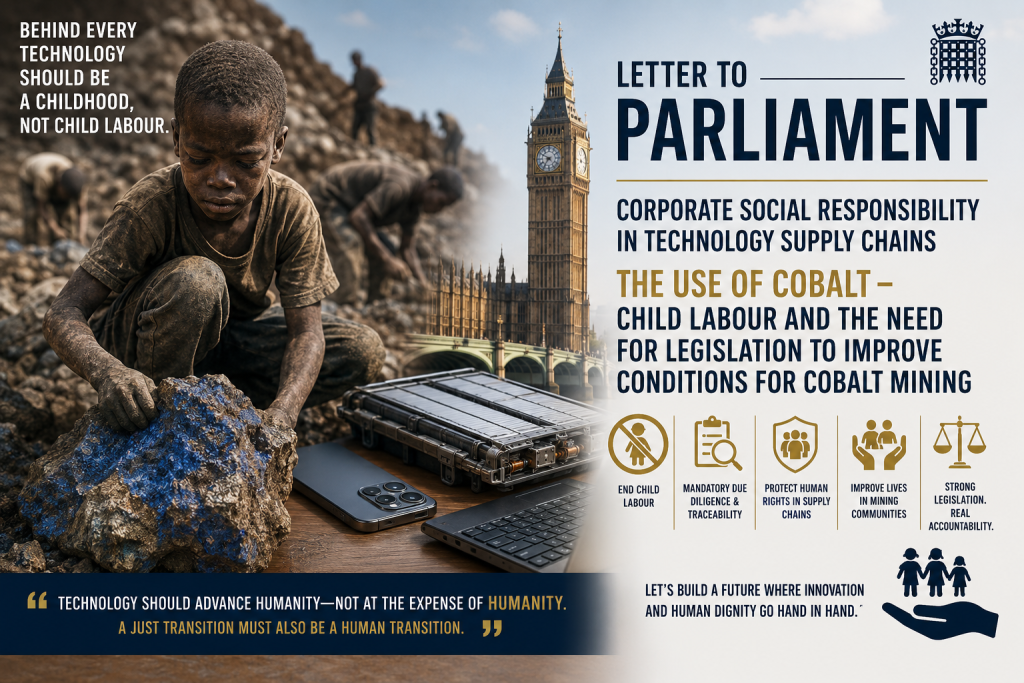
Aug
Subject: The Need for Stronger UK Legislation on Cobalt Supply Chains, Child Labour and Corporate Social Responsibility
Dear Members of Parliament,
I am writing to call upon Parliament to consider stronger legislation governing the responsibility of companies whose products depend upon cobalt and other critical minerals sourced through international supply chains.
Cobalt is an essential mineral in our modern technological economy. It is used within supply chains associated with rechargeable batteries and technologies including smartphones, laptops, electric vehicles and renewable-energy storage.
Yet behind technological progress lies an uncomfortable question:
Do we know enough about the conditions under which the minerals powering our technology are being extracted?
The Democratic Republic of the Congo is the world’s largest supplier of cobalt. International organisations, including the International Labour Organization, continue to document child labour and hazardous working conditions within parts of the country’s artisanal mining sector.
This should concern all of us.
A child should not have to enter a dangerous mine so that someone elsewhere in the world can drive an electric vehicle, use a smartphone or open a laptop.
Corporate Social Responsibility Must Extend to the Source
Technology companies may not directly employ the children or miners involved. Their supply chains can contain numerous intermediaries between the mine, mineral processor, battery manufacturer and final consumer product.
However, distance from the mine should not mean distance from responsibility.
Companies that derive substantial economic benefit from products dependent upon critical minerals should have a responsibility to undertake meaningful due diligence throughout their supply chains.
Corporate Social Responsibility must therefore mean more than publishing sustainability reports or making charitable contributions. It should include responsibility for identifying, preventing and addressing serious human-rights abuses connected with the production of the materials from which companies ultimately benefit.
From Voluntary Responsibility to Legal Accountability
The United Kingdom has already demonstrated international leadership through the Modern Slavery Act 2015. However, the development of increasingly complex global technology and critical-mineral supply chains means that Parliament should consider whether the existing framework now goes far enough.
I respectfully ask Parliament to consider legislation requiring companies placing cobalt-dependent technology products on the UK market to:
- Conduct mandatory human-rights due diligence throughout relevant mineral supply chains.
- Provide meaningful traceability for cobalt, including reasonable efforts to establish where minerals originated and how they entered the company’s supply chain.
- Publish independently verifiable supply-chain reports, rather than relying solely upon corporate self-assessment.
- Demonstrate effective measures to prevent child labour and forced labour within high-risk mineral supply chains.
- Implement remediation programmes where abuses are discovered, recognising that simply terminating suppliers can push vulnerable mining families further into poverty.
- Contribute to improving conditions in mining communities, including safe working practices, education, skills development and sustainable economic alternatives for families whose poverty contributes to child labour.
- Introduce meaningful consequences for serious or repeated failures of due diligence, particularly where companies knowingly ignore credible evidence of exploitation within their supply chains.
A Just Transition Must Also Be a Human Transition
The world is rightly moving towards cleaner technologies, renewable energy and electric transportation.
But environmental sustainability cannot be separated from human sustainability.
We cannot celebrate a greener economy in Britain while ignoring children and vulnerable workers at the beginning of the supply chains that make that economy possible.
The transition to electric vehicles and advanced technologies should create an opportunity to improve conditions in mineral-producing countries—not perpetuate exploitation.
This is not an argument against technology companies, electric vehicles, smartphones or renewable energy.
It is an argument for responsible technology.
Companies should be profitable. Innovation should flourish. The green transition should continue.
But none of these objectives requires us to accept child labour as an unavoidable cost of technological progress.
Britain’s Opportunity to Lead
The United Kingdom has an opportunity to establish a clear principle:
If a company benefits from a global supply chain, it must take reasonable responsibility for what happens within that supply chain.
I therefore respectfully call upon Parliament and His Majesty’s Government to examine the case for strengthened legislation specifically addressing human-rights due diligence, transparency, traceability and remediation within critical-mineral supply chains, including cobalt.
The children living in cobalt-producing communities should not merely be regarded as people at the bottom of a global supply chain.
They should be recognised as children entitled to safety, education, dignity and a future.
Technology should advance humanity—not advance at the expense of humanity.
Yours faithfully,
Daniel Elijah Joseph
Author | Lecturer | Founder, Daniel Elijah Joseph Publications
