
Trump, Netanyahu, World leaders — How Do You Sleep at Night While Gaza Starves ( A 7 part series)
Apr
👉 URGENT:
This vital truth about Gaza’s suffering could disappear any moment.
Download your FREE 7-Part Gaza eBook now — before they take it down!
👉 Secure your copy here before it’s too late!
Part 1 The Politics of Starvation: How Siege Became a Strategy
In the tapestry of human history, the deliberate starvation of civilian populations has often been the mark of ruthless regimes. Gaza today stands as a harrowing testament to this ancient cruelty dressed in modern political garb. The world watches, debates, and negotiates while a people are strangled by hunger—a weapon more silent but no less deadly than bombs and bullets. This is not a byproduct of war. It is the war. Starvation has been transformed into a political strategy, executed with chilling precision.
The Gaza Strip, a narrow enclave home to over two million Palestinians, has been subjected to a brutal blockade by Israel since 2007, when Hamas took control of the territory. The siege has been periodically tightened with every conflict, with food, water, medicine, and electricity used as bargaining chips in a deadly political game. Yet in 2025, the blockade has metastasized into something even more sinister: not merely a “security measure,” but a strategy to induce mass suffering for political ends.
Siege Warfare in the Modern Age
The concept of siege warfare is ancient. Empires from Rome to Britain have used starvation to break the will of the besieged. However, in the 21st century, under international law, collective punishment of civilian populations is illegal. Yet Israel’s siege tactics against Gaza have effectively amounted to a slow-motion war crime, carried out in broad daylight.
Israeli government documents that surfaced in 2012 revealed that officials had calculated the minimum caloric intake needed to avoid mass malnutrition in Gaza. Far from a humanitarian measure, this calculation allowed them to tighten imports just enough to cripple life without provoking outright global outrage. It was a balancing act: starve them, but not to death. Maintain the illusion of “security,” while engineering humanitarian disaster.
Trump’s administration, rather than seeking to end or ease this humanitarian nightmare, emboldened it. Under Trump’s tenure, the United States slashed funding to UNRWA, the UN agency tasked with providing aid to Palestinian refugees, exacerbating food insecurity. Meanwhile, political cover was provided to Israel at every international forum. Gaza became a political sacrifice offered on the altar of strategic alliances.
Political Decisions That Fueled the Famine
A humanitarian crisis of this magnitude does not occur spontaneously. It is crafted, piece by piece, by political decisions made in gleaming offices far from the dust and decay of Gaza’s refugee camps.
The blockade imposed by Israel—supported by Egypt—has restricted the movement of goods and people. Food, medicine, fuel, building materials—anything that could allow life to stabilize—has been heavily controlled or outright banned. Even items like chocolate and toys were, at one point, restricted, in an apparent bid to break the spirit of Gaza’s youth.
After Trump recognized Jerusalem as Israel’s capital in December 2017, tensions escalated, leading to bloody confrontations. The political signal was clear: Palestinian suffering was not a factor in American policy calculus. This move emboldened further crackdowns and deepened Gaza’s isolation.
The so-called “Deal of the Century,” presented by Trump and Jared Kushner, only legitimized the siege by offering Palestinians a fragmented, economically dependent pseudo-state while recognizing Israeli sovereignty over large parts of the West Bank. For Gaza, already economically paralyzed, the “deal” was a death knell disguised as diplomacy.
In 2023 and beyond, as the world shifted its attention to other crises, Netanyahu’s government, facing its own political scandals, further tightened the screws on Gaza. Crossings were closed. Aid was delayed or denied. Agricultural lands were destroyed. Fishing zones were severely restricted. Each act contributed to an economy of despair, where starvation was not just a consequence but a calculated policy.
Starvation as Psychological Warfare
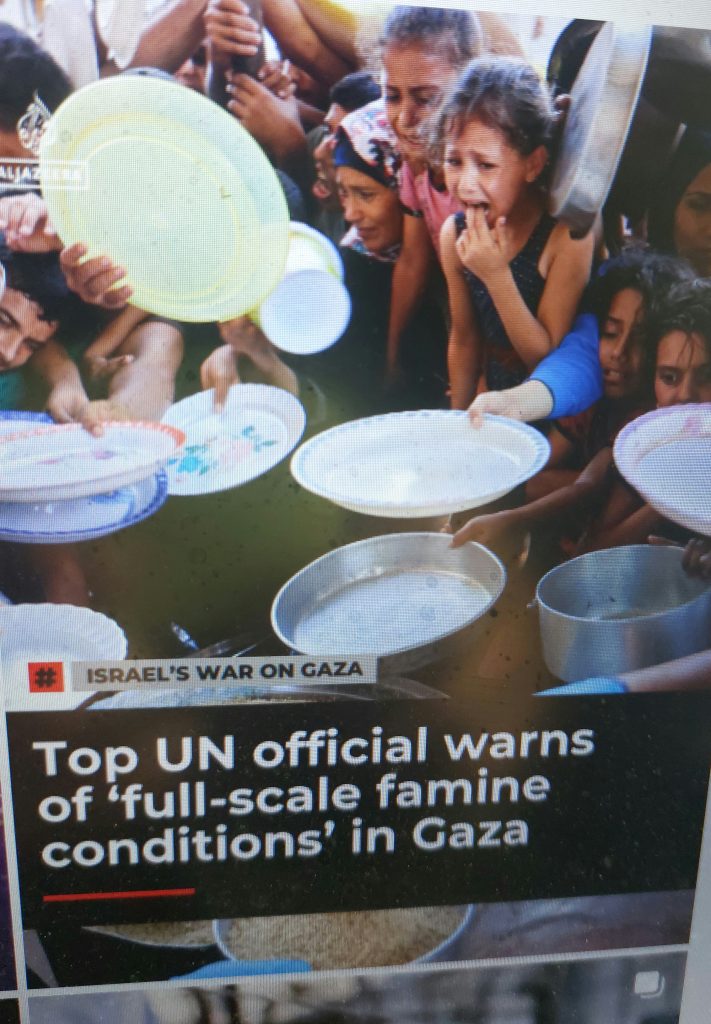
Beyond physical suffering, starvation is a tool of psychological domination. It sends a clear message: you are powerless. It erodes the very fabric of human dignity, turning parents into beggars and children into skeletal reminders of political failure.
For a people already traumatized by wars, bombings, and displacement, starvation compounds the wounds. Malnutrition affects not just the body but the mind, impairing cognitive development in children and deepening cycles of poverty and despair.
International agencies have warned for years that Gaza is “unlivable.” But the political powers responsible for its condition are not merely indifferent—they are actively invested in sustaining the siege. Gaza’s suffering serves multiple purposes: a warning to other Palestinians, a rallying cry for internal political unity in Israel, and a bargaining chip in negotiations.
Starvation becomes, in this cynical calculus, a form of communication: a language of power spoken in the growling stomachs of the innocent.
Complicity Beyond Borders
While Israel and its leaders bear primary responsibility for the blockade, they are not alone in their culpability. The international community’s failure to hold Israel accountable has enabled the siege to persist.
The United States, under Trump and continuing under successive administrations, provided diplomatic cover. The European Union, despite occasional condemnations, maintained trade agreements and failed to leverage its considerable economic influence. The Arab states, many of whom normalized relations with Israel under the Abraham Accords, largely abandoned the Palestinian cause in favor of economic and security ties.
Gaza was left to rot in a political no-man’s land, with the suffering of its people reduced to background noise in a world addicted to sensational headlines and fleeting sympathy.
The Human Face of a Political Strategy
Behind the statistics lie human beings: mothers who cannot feed their children, fathers who cannot find work, children who collapse from hunger in overcrowded hospitals that lack medicine, power, and clean water.
Consider Amal, a 7-year-old girl in Gaza City, whose growth has been permanently stunted by chronic malnutrition. Or Sami, a former fisherman whose livelihood was destroyed when the fishing zone was reduced to a few nautical miles. Or Layla, a widow who must decide daily whether to spend her last few shekels on bread or medicine for her sick son.
These are not incidental tragedies. They are the intended outcomes of a system designed to break a people’s will.
Media Manipulation and Narrative Control
One of the key strategies employed to mask the siege’s brutality has been the manipulation of narratives. Israeli officials and sympathetic media often frame the blockade as a necessary measure to contain Hamas terrorism.
While security concerns are real, the collective punishment of an entire population cannot be justified under international law. Yet by framing every Palestinian as a potential threat, the siege is normalized in public discourse.
The Trump administration amplified this narrative, often portraying Palestinians as obstinate aggressors rather than victims of an illegal occupation. In doing so, it provided ideological cover for policies that should have been universally condemned.
A War Crime by Any Other Name
International law is clear: Article 33 of the Fourth Geneva Convention explicitly prohibits collective punishment. Deliberately depriving a civilian population of food, water, and medicine is a violation of humanitarian law and can constitute a war crime.
Yet accountability remains elusive. Israel, shielded by powerful allies and an often-complicit media landscape, faces little meaningful consequence. The International Criminal Court (ICC) has opened investigations, but political pressure, particularly from the United States and Israel, has stymied progress.
The result is a grotesque spectacle: children starve while diplomats debate definitions.
The Urgency of Recognition
Recognizing the politics of starvation is the first step toward ending it. To see Gaza’s suffering not as an unfortunate byproduct of conflict but as a deliberate strategy forces a moral reckoning upon the world.
It is not enough to send aid after bombings or to issue statements of concern. The siege must be named for what it is: a systematic, calculated act of violence against an entire population. Only then can the path to justice—and to life—begin.
Conclusion: The Weaponization of Hunger
Gaza’s starvation is a choice made by those in power. Trump, Netanyahu, and their enablers have crafted a reality where the most vulnerable are punished for political resistance they often have no part in.
As we bear witness to Gaza’s suffering, we must also bear responsibility. Silence is complicity. Denial is participation. And history will remember not only the architects of this cruelty but those who, having seen the truth, chose to look away.
Free Gift for You:
The truth about Gaza’s suffering must never be buried.
Download your FREE copy of the exclusive 7-Part Gaza eBook and uncover what world leaders don’t want you to see.
👉 Click here to get your FREE eBook now.
Together, let’s shine a light where others try to keep it hidden.
About the Author
Daniel Elijah Joseph is a fearless voice for the voiceless, blending spiritual insight with unflinching advocacy for truth, justice, and human dignity. His writing exposes the hidden forces behind global suffering and calls readers to reject complacency in the face of oppression.
Through his platform, DanielElijahJoseph.com, Daniel empowers individuals to rise above fear, confront injustice, and walk boldly in their divine calling. His work refuses to sanitize hard truths, choosing instead to illuminate them — because silence in the presence of evil is complicity.
Discover more of his powerful message and mission at DanielElijahJoseph.com.
