
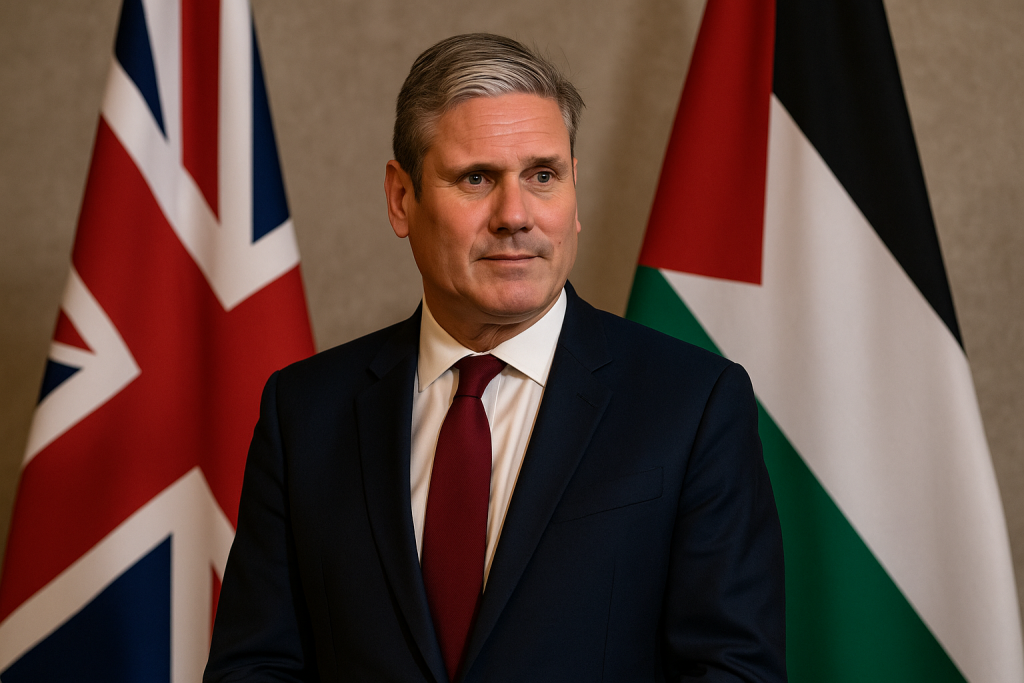
Well Done Prime Minister Starmer – UK Recognises the State of Palestine
Sep
Europe’s Rise: Why the US No Longer Leads the World
History often turns on symbolic yet decisive actions. In a world where justice is frequently delayed, the United Kingdom’s recognition of the State of Palestine under Prime Minister Keir Starmer marks such a moment. More than just a diplomatic gesture, it is a tectonic shift in global power relations. Europe has taken the moral and political high ground, positioning itself as the voice of justice and balance in a conflict where the United States has too often been silent, complicit, or hesitant.
For decades, Palestine’s quest for recognition has been entangled in the politics of power. Successive US administrations promised much but delivered little, bound tightly to the interests of Israel and the complex lobbying networks that shape Washington’s foreign policy. By contrast, Starmer’s move reflects a growing European conviction that leadership today is not defined by military might alone but by moral courage, humanitarian responsibility, and the ability to re-frame the global narrative.
A Defining Moment for the UK
Prime Minister Starmer’s recognition of Palestine is not just another line in the foreign policy record. It signals a departure from the passive diplomacy that has too often characterised the UK’s stance in the Middle East. The UK has historical responsibility in the region, from the Balfour Declaration to its role as a former colonial power. Recognition of Palestine is, in many ways, an act of reckoning with history — a long overdue acknowledgement that the Palestinian people deserve the dignity of statehood and sovereignty.
By taking this step, the UK aligns itself with justice, balance, and reconciliation rather than endless cycles of violence. It positions Britain not as a follower of Washington’s lead but as a nation capable of shaping a new global reality.
Europe Filling the Leadership Void
While the United States remains militarily dominant, its moral authority has eroded. From the invasion of Iraq to the uncritical support of policies that perpetuate Palestinian suffering, Washington’s credibility as a neutral broker has been shattered. Its repeated use of the UN Security Council veto to block resolutions favouring Palestinian rights exposed its bias and undermined its leadership role.
Europe, meanwhile, has quietly been preparing for this moment. Several European nations — Sweden, Ireland, Spain, and others — have already recognised Palestine, and more have expressed growing impatience with America’s unwillingness to lead responsibly. The UK’s recognition under Starmer accelerates this shift, making Europe the epicentre of a new moral leadership.
This is not simply about foreign policy; it is about redefining the architecture of global power. Leadership today is measured not only by hard power but also by the ability to inspire trust, bridge divides, and side with justice even when inconvenient.
The Decline of US Influence
The US once prided itself as the global leader and defender of democratic ideals. Yet, when it comes to Palestine, America has consistently failed to apply its own principles. Its alignment with Israeli hardline policies has left it isolated, distrusted, and increasingly irrelevant to peace negotiations.
In the eyes of much of the world, Washington no longer leads by moral example. Its silence in the face of humanitarian catastrophes in Gaza, its double standards in international law, and its prioritisation of strategic alliances over justice have all weakened its global standing.
Europe’s rise, therefore, is not just opportunistic — it fills a vacuum left by the US. By recognising Palestine, the UK signals that global leadership is shifting westward across the Atlantic.
Symbolism and Substance
Some critics may argue that recognition alone does not resolve the complex realities on the ground: borders, security, refugees, and the contested status of Jerusalem. That is true. But recognition changes the framework of discussion. It shifts Palestine from being seen as a “territorial dispute” to being acknowledged as a people with a legitimate statehood claim.
Symbolism matters in international relations. Just as Nelson Mandela’s struggle was strengthened by symbolic acts of recognition and solidarity, so too does Palestine’s recognition build momentum for justice. It affirms to the world that the Palestinian people are not forgotten, that their right to self-determination is not negotiable, and that their suffering cannot be indefinitely ignored.
Europe as the New World Leader
Europe’s recognition of Palestine is part of a wider transformation. In the face of climate change, refugee crises, digital governance, and now Middle East peace, Europe has been carving out a reputation as the champion of multilateralism and humanitarian responsibility. The European Union and individual nations are increasingly driving the conversations that matter most for the future of humanity.
While the United States retreats into nationalism and selective engagement, Europe is building alliances, promoting dialogue, and standing firm on international law. In doing so, Europe is not only filling the leadership vacuum but redefining leadership itself. It is proving that leadership rooted in justice, peace, and global solidarity carries more weight than leadership rooted in dominance and coercion.
A New Global Reality
The recognition of Palestine by the UK is more than a bilateral gesture. It marks the dawn of a new global reality where Europe, not the United States, sets the tone for justice in world affairs. For Palestinians, it offers hope. For Israelis, it signals that the world will no longer tolerate endless occupation. For the rest of the world, it demonstrates that nations can choose moral courage over political convenience.
It is also a challenge to the United States: reform your foreign policy or accept irrelevance in the moral and diplomatic arena.
Conclusion: A Historic Turning Point
Prime Minister Keir Starmer’s recognition of Palestine will be remembered not only as a bold foreign policy decision but as a historic turning point. It crystallises Europe’s rise as the new moral compass of the world and accelerates the decline of America’s global influence.
In recognising Palestine, the UK has acknowledged a truth long denied: that peace without justice is impossible, and that justice requires recognising the rights and dignity of both peoples.
History will judge nations not by their power but by their principles. On this day, Europe rose to lead, and the United States stepped back. The future belongs not to those who cling to old empires of dominance, but to those who have the courage to speak truth, act justly, and lead the world towards a fairer tomorrow.
About the Writer
I’m Daniel Elijah Joseph — a lecturer, writer, and observer of world affairs. My passion lies at the crossroads of spirituality, justice, and leadership. Through my books, blogs, and teachings, I seek to uncover the deeper patterns shaping humanity — whether in politics, finance, or personal transformation.
I believe that true leadership is rooted in wisdom, courage, and alignment with higher principles. My writing is not just about events; it’s about their meaning. When I reflect on decisions like Prime Minister Keir Starmer’s recognition of the State of Palestine, I see them not only as political milestones but as spiritual and moral turning points for our shared future.
You can follow my work at 🌐 DanielElijahJoseph.com, where I share insights on purpose, empowerment, and the shifting tides of our world.
