
Gratitude: The Sacred Chemistry That Turns Heaviness into Light
Jun
There are moments in life when the weight of circumstances feels overwhelming.
Responsibilities increase.
Challenges arise.
Uncertainty lingers.
In such moments, gratitude may seem like the last thing on a person’s mind.
Yet throughout history, gratitude has been recognised as one of the most powerful practices for transformation.
This is why the statement is so profound:
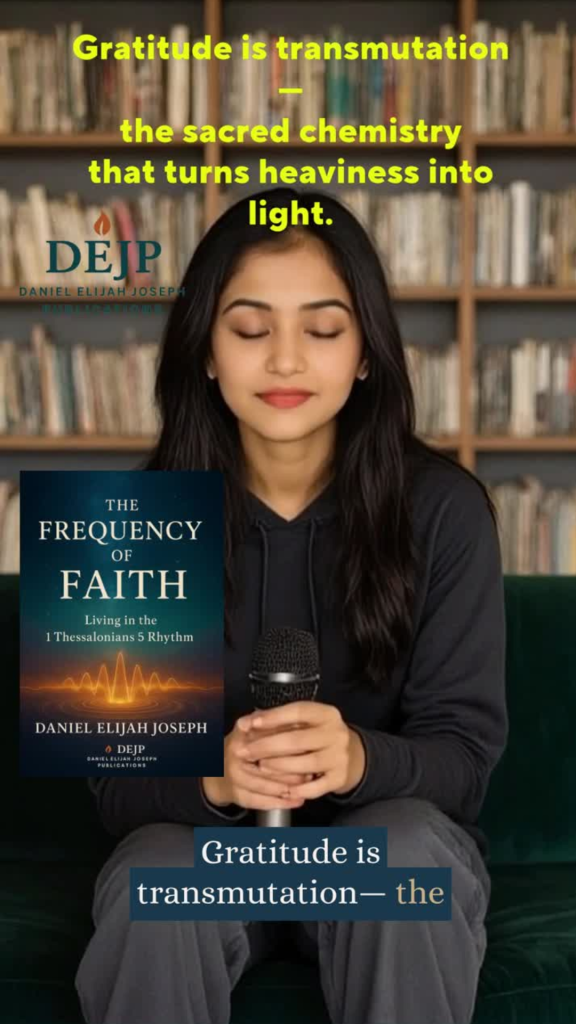
“Gratitude is transmutation—the sacred chemistry that turns heaviness into light.”
The Alchemy of Perspective
Transmutation is the process of changing one thing into another.
In ancient traditions, alchemy sought to transform base metals into gold.
Spiritually and psychologically, gratitude performs a similar function.
It transforms perspective.
The circumstance may remain unchanged, but the way we experience it begins to shift.
Gratitude does not always change the world around us.
It often changes the world within us.
Gratitude Is Not Denial
Some people misunderstand gratitude.
They imagine it requires pretending everything is perfect.
But gratitude is not denial.
It does not ignore pain.
It does not dismiss difficulty.
Rather, gratitude acknowledges hardship while also recognising that hardship is not the whole story.
Even in difficult seasons, there remain reasons for hope:
- Relationships that sustain us
- Lessons that shape us
- Opportunities for growth
- Simple gifts often overlooked
The Science of Gratitude
Modern psychology increasingly supports what ancient wisdom has long taught.
Research suggests that gratitude practices can improve wellbeing, reduce stress, and strengthen resilience.
When people intentionally focus on what is good, their emotional landscape often changes.
The mind begins noticing possibilities rather than only problems.
Lightening the Inner Burden
Many burdens become heavier because they are carried alone.
Gratitude creates space for perspective.
It reminds us that life contains more than difficulty.
The thankful heart often discovers strength where despair expected weakness.
This does not remove every challenge.
But it changes how challenges are carried.
Gratitude and Faith
Faith and gratitude are closely connected.
Gratitude remembers.
Faith anticipates.
Gratitude looks back and says:
“I have been helped before.”
Faith looks forward and says:
“There is reason to hope again.”
Together, they create resilience.
Small Practices, Great Change
Gratitude does not require extraordinary circumstances.
It can begin with small moments:
- A sunrise
- A kind word
- Good health
- Friendship
- A lesson learned
- Another day of life
Small acknowledgements repeated daily create profound transformation over time.
The Atmosphere We Carry
Every person carries an atmosphere.
Some carry anxiety.
Some carry bitterness.
Others carry gratitude.
A grateful spirit often influences not only personal wellbeing but also relationships and communities.
Gratitude spreads.
It changes conversations.
It changes perspectives.
It changes lives.
Turning Heaviness into Light
The beauty of gratitude is not that it removes every burden.
Its beauty lies in its ability to illuminate even difficult seasons.
It transforms scarcity into appreciation.
Fear into trust.
Heaviness into hope.
The Invitation
Perhaps gratitude is more than a polite response.
Perhaps it is one of life’s deepest spiritual practices.
A practice that reshapes the heart.
A practice that renews the mind.
A practice that turns heaviness into light.
Because gratitude is not merely saying “thank you.”
It is learning to see differently.
And sometimes, seeing differently changes everything.
📘 Ready to discover the transformative power of faith, gratitude, and joy?
Explore The Frequency of Faith – Living in the 1 Thessalonians 5 Rhythm by Daniel Elijah Joseph — available now at the DEJ Publications Store on Danielelijahjoseph.com and Amazon.
👉 Get your copy today.
✨ Visit Danielelijahjoseph.com for more empowering insights on faith, gratitude, and personal transformation.
