
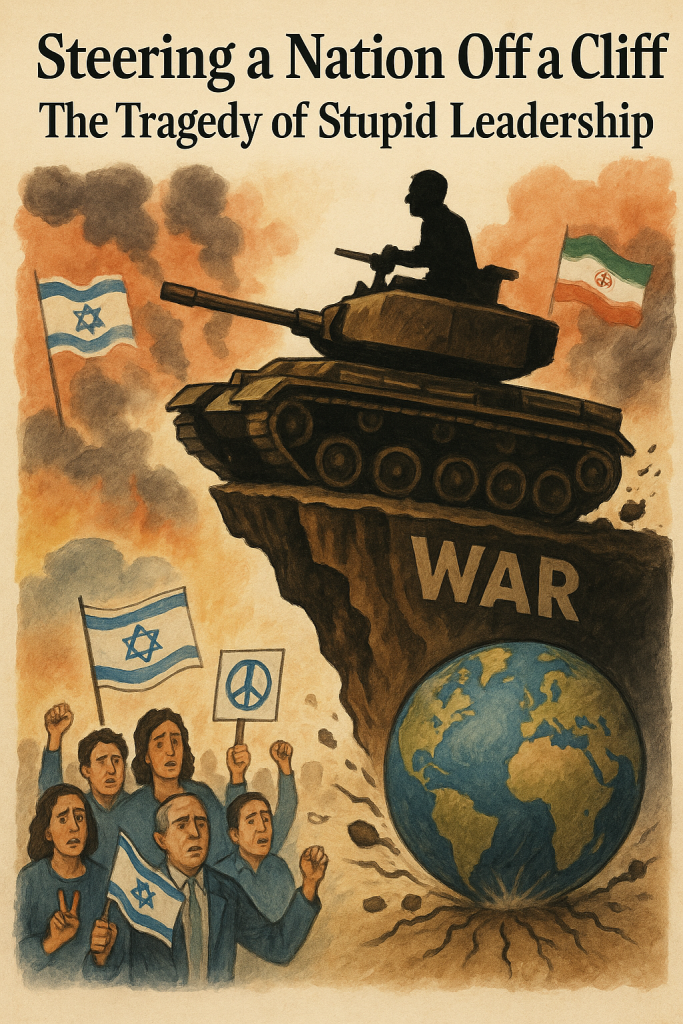
Steering a Nation Off a Cliff: The Tragedy of Stupid Leadership
Jun
In the quiet hours of the early morning on June 13th, 2025, the world watched in disbelief as Israel, under Prime Minister Benjamin Netanyahu’s leadership, launched a bold and dangerous strike on Iranian military infrastructure. What followed was no less shocking—Iran’s swift retaliation intensified a regional conflict already on a knife’s edge. With both nations engaging in tit-for-tat attacks, the fear of a full-scale war has turned into a grim possibility.
This is not just a political miscalculation; it is a failure of leadership at the highest level. Once again, Netanyahu has proven himself not as a protector of peace, but as a provocateur of perpetual war.
A Leader Obsessed with War
Why does Benjamin Netanyahu appear to crave war so much? This question haunts not only Israelis but the global community. Since the beginning of his political career, Netanyahu has framed Israel’s survival around existential threats—some real, others grossly inflated. His tenure has been marked by relentless confrontation, fear-driven rhetoric, and an almost messianic belief that only he can protect the Jewish state from annihilation.
But the reality tells a different story: Netanyahu’s militaristic obsessions have not made Israel safer—they have isolated it, made it a target of increasing hatred, and drawn its citizens into endless cycles of bloodshed. At what point does the nation say enough?
The Attack on Iran: Reckless and Irresponsible
Netanyahu’s latest assault on Iran was reckless, especially given the fragile global landscape. With tensions already high in the Middle East, the decision to strike Iran was neither strategic nor necessary—it was inflammatory.
Iran, though a rival, is not a nation to be bullied without consequence. Netanyahu, blinded by his own delusions of invincibility, either ignored or underestimated Iran’s capacity and willingness to respond. The retaliatory strikes that followed put Israeli civilians at risk, sent shockwaves through global financial markets, and drew condemnation even from some of Israel’s allies.
No longer can this be spun as defense. It is hubris masquerading as security policy. And the world is growing tired of it.
A Liability for Israel and the World
Netanyahu’s policies have repeatedly put Israel on a collision course with disaster. His approach to leadership thrives on division—internally and externally. Instead of building coalitions for peace, he bulldozes diplomacy with brute force. Instead of embracing compromise, he entraps his nation in a bunker mentality, surrounded by enemies both real and imagined.
He has burned bridges with allies in Europe, alienated large sections of the Jewish diaspora, and turned Israel into a political lightning rod on the global stage. In truth, Netanyahu is no longer an asset to Israel’s future. He is a liability.
And it’s not just Israel that suffers from his poor leadership. The entire region, already fragile, is pushed closer to collapse by every rash decision he makes. The world watches nervously, knowing that one more impulsive move could ignite a regional—or even global—conflict.
The Cost of One Man’s Ego
Leadership is a sacred responsibility—especially in a region as complex and sensitive as the Middle East. Yet Netanyahu has used his role not as a steward for the people’s wellbeing, but as a platform for power consolidation and personal legacy.
This isn’t new. For years, his political strategy has been rooted in fearmongering, nationalism, and deflection. Faced with criminal investigations, domestic unrest, and growing discontent, he often turns to military escalation as a distraction. War, for Netanyahu, is not just policy—it is political theater. And too often, Israeli lives become the collateral damage.
We must ask ourselves: How many more lives must be lost to sustain one man’s obsession with control?
Time for Netanyahu to Retire from Politics
History is filled with leaders who overstayed their welcome—men who believed themselves indispensable, even as their nations suffered under their rule. Netanyahu now joins that infamous list. His reign, extended far beyond its usefulness, has left Israel bruised, paranoid, and increasingly isolated.
The honorable path forward is clear: it is time for Netanyahu to retire from politics. Not out of spite, but out of necessity.
Israel deserves a leader who seeks peace—not one who perpetuates war. It needs someone who understands that true strength is measured not by missiles fired but by lives preserved. It needs a leader who will engage the international community with wisdom, humility, and the courage to change course.
Most of all, Israel needs healing. The nation is tired—tired of war, tired of fear, tired of the same recycled rhetoric from a man who long ago stopped listening to his people.
The Global Community Must Speak Up
The international community must not remain silent. The United Nations, European Union, African Union, Arab League, and even the United States—traditionally Israel’s strongest ally—must recognize that silence in the face of reckless leadership is complicity.
Diplomatic pressure must be applied. Sanctions must be considered. Dialogue must be prioritized over weaponry. The stakes are simply too high.
We cannot afford another war driven by ego. We cannot afford more civilian casualties while leaders play war games. And we certainly cannot allow one man’s thirst for legacy to drag the world into darkness.
Final Thoughts: The Tragedy of Misguided Leadership
When a leader miscalculates, it is not just policy that suffers—it is people. Lives are lost. Homes are destroyed. Futures are rewritten in blood. That is the real tragedy of stupid leadership.
Benjamin Netanyahu has steered his nation off a cliff—and the fall may not be over yet. But Israel, like any nation, has a choice. It can continue down this path of destruction, or it can choose a new direction—one rooted in wisdom, justice, and peace.
For Israel’s sake, for the Middle East, and for the world—it’s time for change.
✍️ About the Author:
Daniel Elijah Joseph is a writer, lecturer, and visionary thinker dedicated to truth-telling in turbulent times. With a passion for justice, spiritual wisdom, and responsible leadership, his work bridges current affairs with deep insight. Daniel is the founder of Daniel Elijah Joseph Publications and the voice behind powerful pieces that challenge the status quo and awaken hearts.
Connect at: www.DanielElijahJoseph.com
