
Is Sadness a Lack of Faith? The Truth
Aug
A worship song can be playing, Scripture can be open on the table, and yet your heart may still feel unbearably heavy. In that moment, the question, is sadness a lack of faith, can feel less like a theological question and more like an accusation. You may wonder why you are not stronger, happier, or more victorious.
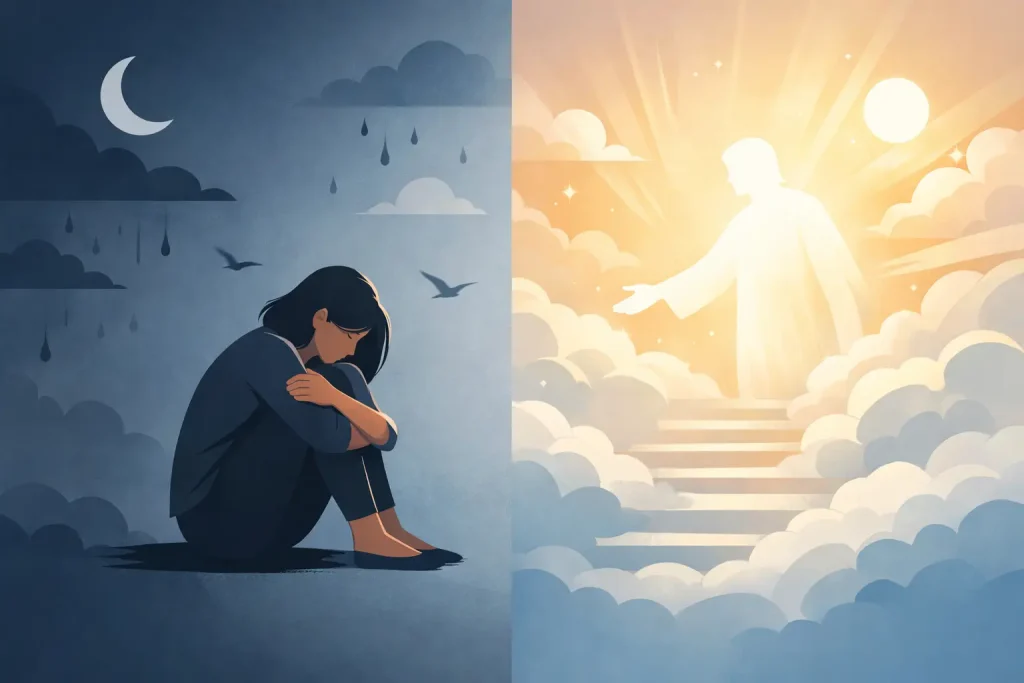
But sadness is not automatic proof that your faith has failed. It is often proof that you are human, that something mattered, that a wound needs care, or that your soul is carrying more than it was designed to carry alone. Faith is not pretending that pain is absent. Faith is choosing to bring your real pain into God’s presence.
Is sadness a lack of faith, or a signal from the soul?
Sadness can arise for many reasons: bereavement, disappointment, loneliness, exhaustion, conflict, rejection, trauma, hormonal changes, financial pressure, or a season of unanswered prayer. None of these experiences makes you spiritually inferior. A tearful heart is not necessarily a faithless heart.
The Bible does not present faithful people as emotionally untouched. David wrote prayers from places of deep distress. Elijah, after a great spiritual victory, reached a point of profound exhaustion and despair. Jesus Himself wept. These are not stories of people abandoned by God because they felt deeply. They are reminders that sorrow and faith can exist in the same heart.
There is a difference between having sadness and allowing sadness to become the final authority over your life. Faith does not demand that you deny the feeling. It invites you to refuse to build your identity, future, and theology around the feeling. You can say, “I am sad,” without declaring, “I have no hope.”
That distinction creates room for healing. Suppressed emotion often becomes heavier. Honest emotion, offered to God, can become a doorway to comfort, wisdom, and inner restoration.
Faith does not mean forced happiness
Some believers have been taught, directly or indirectly, that a joyful appearance is evidence of spiritual maturity. So they learn to smile while their inner world is collapsing. They use spiritual language to avoid grief, call emotional numbness peace, and treat every difficult feeling as something to rebuke immediately.
Yet forced happiness is not the same as joy. Biblical joy is deeper than a pleasant mood. It is the settled assurance that God remains present, good, and powerful even when your circumstances are painful. It can coexist with tears.
You do not need to perform cheerfulness for God. He already knows what is in your heart. Prayer is not a stage where you offer polished words and impressive faith statements. It is a place of encounter. Sometimes the most powerful prayer is simply: “Father, I am tired. I do not understand this. Please hold me.”
That is not weak faith. That is surrendered faith.
Lament is not unbelief
Lament gives pain a voice before God without giving pain the throne. It tells the truth about loss while still turning towards the One who heals. There is a holy difference between complaining about God and crying out to God.
When you lament, you are not moving away from faith. You are exercising faith because you are bringing your grief to the One you believe can receive it. You are refusing isolation. You are choosing relationship over pretending.
A faith that has no language for sorrow can become brittle. But a faith that can weep, wait, worship, and rise again develops spiritual depth. It becomes tested, tender, and rooted.
When sadness needs more than a prayer moment
Prayer matters. Worship matters. Speaking God’s truth over your mind matters. But spiritual practices do not cancel the need for rest, wise conversation, medical care, counselling, or practical change. God can work through a prayer closet, a trusted pastor, a therapist, a GP, a supportive friend, and a healthier daily rhythm.
Sometimes sadness is a passing response to a difficult day. Sometimes it is grief that needs time and gentleness. Sometimes it may be connected to depression, anxiety, trauma, or another health concern that deserves professional support. The faithful response is not always to push harder. At times, it is to receive help with humility and courage.
If low mood persists, affects sleep, appetite, work, relationships, or your ability to care for yourself, speak to your GP or a qualified mental-health professional. If you are having thoughts of harming yourself or feel unable to stay safe, seek urgent help through local emergency services or a crisis service immediately. Reaching for support is not a contradiction of faith. It is an act of valuing the life God has entrusted to you.
God’s healing can be miraculous, gradual, or supported through many means. Do not limit His care to the method you expected.
What faith looks like in a sad season
Faith in a sad season may not look dramatic. It may look like getting out of bed and opening the curtains. It may look like drinking water, eating something nourishing, going for a walk, or sending one honest message to a safe person. These small acts are not insignificant. They can be part of rebuilding your inner strength.
It may also look like guarding what feeds despair. Constant bad news, comparison, isolation, unresolved conflict, and a lack of sleep can drain your emotional and spiritual reserves. You cannot always change the source of your sadness, but you can begin to notice the environments, thoughts, and patterns that intensify it.
Try bringing a simple rhythm to your day. Begin with a few quiet minutes before God, not to manufacture a feeling but to become available to His presence. Read a short passage slowly. Write down what you are carrying. Speak one truthful declaration aloud: “My feelings are real, but they are not my master. God is with me in this moment.”
Then take one practical step. Faith becomes tangible when it moves through the body, the mind, and the choices you make. A walk can clear mental fog. Rest can restore perspective. A difficult conversation can release pressure. Professional support can help you recognise patterns that prayer alone has not yet brought into focus.
Replace shame with discernment
Shame asks, “What is wrong with me?” Discernment asks, “What is happening within me, and what do I need?” Shame drives you into hiding. Discernment brings you into the light.
Do not use faith as a weapon against your own soul. Ask God for wisdom to understand whether you are grieving, depleted, disappointed, isolated, or carrying an old wound. Invite Him to show you the root, not merely silence the symptom.
This is where inner healing becomes powerful. You may discover that your sadness is not proof of a lack of faith but a call to release something you have carried for too long. The Holy Spirit does not expose pain to humiliate you. He reveals what is hidden so that freedom can begin.
Hope is stronger than denial
Hope is not saying that everything is fine when it is not. Hope is declaring that this pain does not have the final word. It is trusting that God can bring comfort without making light of the loss, and purpose without calling the wound good.
You may not feel victorious today. That does not mean victory is absent from your story. Healing often begins quietly, beneath the surface, before it becomes visible in your emotions. A seed does not look like a tree while it is underground, but life is still working within it.
Let yourself be honest. Let yourself be supported. Let God meet you without the mask. Your sadness may be real, but it is not your identity, your destiny, or the measure of your faith. Bring your whole heart to God today, including the part that hurts, and trust that His presence can hold what you cannot carry alone.
