
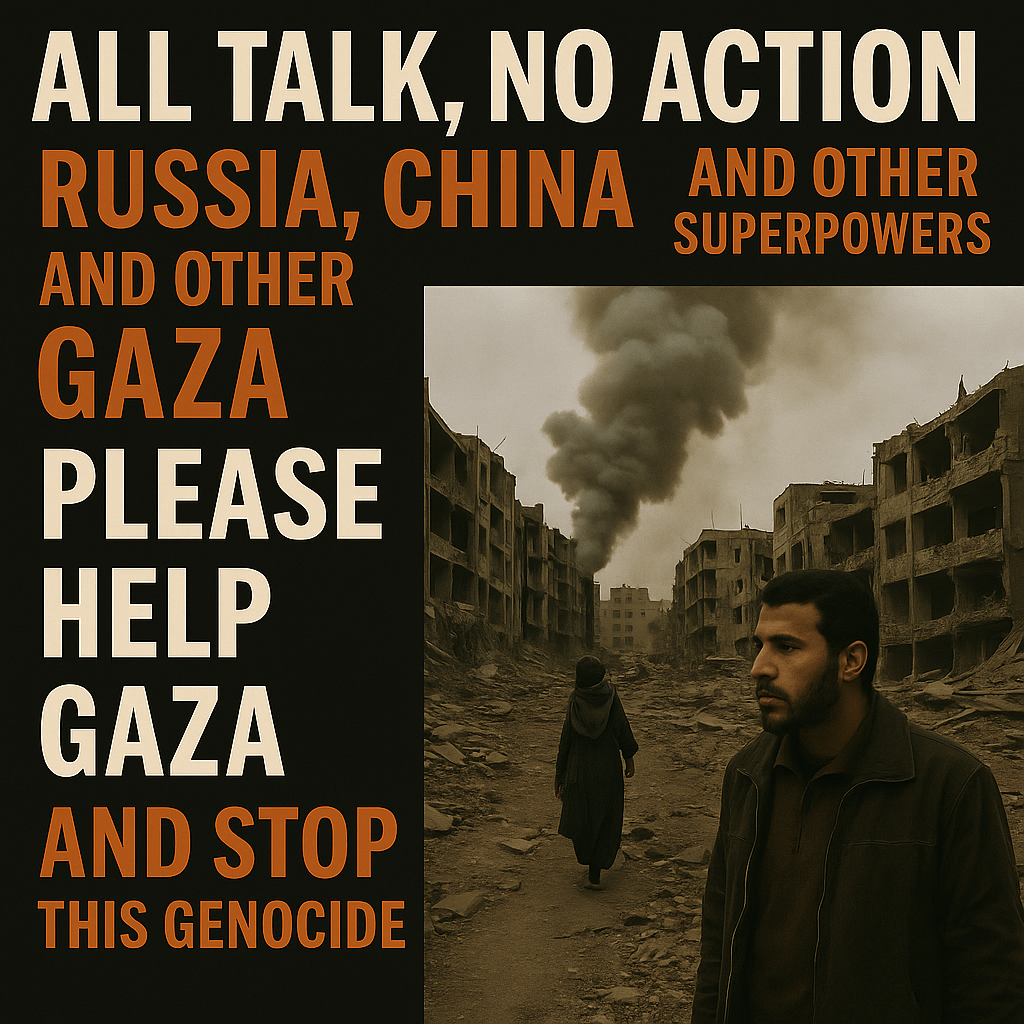
All Talk, No Action: Russia, China, and the Superpowers Please Help Gaza and Stop This Genocide
Sep
For months, Gaza has burned under relentless bombardment. Families are torn apart, hospitals lie in ruins, and children’s cries echo in streets reduced to rubble. The images have flooded global screens, sparking outrage, hashtags, and speeches from world leaders. Yet, beyond the sound bites and declarations, the reality remains stark: Gaza is still bleeding, and the superpowers—Russia, China, the United States, and others—remain stuck in a cycle of rhetoric without meaningful intervention.
This is not just a humanitarian crisis; it is a genocide unfolding in real time. To call it anything less would be to strip away the human cost and reduce lives to statistics.
Global Indifference in the Face of Suffering
Each time the United Nations convenes, we hear the familiar chorus: calls for restraint, demands for ceasefires, and stern warnings. But where are the teeth behind these words?
Russia and China position themselves as counterweights to Western dominance, often criticizing the U.S. for its unconditional support of Israel. Yet their own responses to Gaza’s plight amount to little more than carefully worded statements. Moscow and Beijing have both used their seats on the Security Council to back resolutions calling for humanitarian pauses, but beyond the vote, what action has followed?
The truth is, geopolitical competition has overshadowed humanitarian urgency. For the superpowers, Gaza has become a stage to project influence, not a people to be saved.
The U.S. Factor
The United States is arguably the single most influential actor in the Israel-Palestine conflict. Washington’s military aid and political backing give Israel confidence to continue its campaigns with impunity. While President after President has spoken of a two-state solution, the reality is that U.S. foreign policy has enabled the continuation of occupation and, now, devastation.
Russia and China frequently point fingers at the U.S. for this imbalance. But finger-pointing does not stop bombs from falling. If they truly wish to position themselves as global leaders, they must do more than capitalize on American hypocrisy.
A Moral Failure of the International Community
When we strip away the politics, one truth remains: civilians in Gaza are enduring unspeakable horrors. Entire families have been erased. Schools and mosques—once sanctuaries—are reduced to dust. Water, electricity, and medical supplies are scarce.
And yet, the so-called guardians of international law—the nations with the power, resources, and leverage to intervene—have chosen caution over courage. For ordinary people around the world, the dissonance is maddening: how can leaders so quick to mobilize billions for wars elsewhere suddenly move at a snail’s pace when it comes to saving Palestinian lives?
The genocide continues precisely because speeches cost nothing, while real action demands sacrifice, risk, and political will.
The Superpower Stalemate
Russia is entangled in its own war in Ukraine, seeking allies where it can and often using Palestine as a talking point to expose Western double standards. China presents itself as a broker of peace in the Middle East, having recently mediated between Saudi Arabia and Iran, yet has stopped short of applying direct pressure on Israel or its backers.
Both nations know that humanitarian leadership would elevate their global standing. Yet neither has dared to go beyond symbolic moves—dispatching aid convoys, issuing statements, or offering diplomatic sound bites.
The result? A stalemate that costs Palestinian lives daily.
Why the World Can No Longer Afford Silence
The case for urgent action is not only moral—it is practical. Every day the war drags on, the risk of regional escalation grows. Lebanon, Syria, and even Iran are drawn closer to the conflict’s edge. Millions across the Arab and Muslim world are radicalized by images of Gaza’s destruction, fueling cycles of anger that will haunt future generations.
If superpowers will not act to protect Palestinians, they should at least recognize the self-interest in preventing chaos that will inevitably spill beyond Gaza’s borders.
What Must Be Done
Words alone will not stop this genocide. The world needs action:
- Immediate, Enforceable Ceasefire
Not a pause. Not a “humanitarian corridor.” A ceasefire enforced by the international community to halt the bombs and allow aid to flow. - International Peacekeeping Force
The deployment of a multinational protection mission under UN mandate—backed by Russia, China, and Western powers—is essential. A peacekeeping force with a clear mandate to protect civilians and guarantee the flow of aid would send the message that the world will not stand by while genocide unfolds. - Accountability Through International Law
The International Criminal Court must be empowered—and supported—to investigate and prosecute war crimes without political interference. - Humanitarian Intervention
Superpowers must coordinate the delivery of food, water, and medicine at a scale that matches the crisis. Symbolic aid shipments are not enough. - Diplomatic Leverage
Nations with economic and military ties to Israel—chief among them the United States—must be pressured into conditioning support on the protection of civilian life. - A Path to Real Peace
The two-state solution cannot remain a hollow phrase. Concrete steps must be initiated toward Palestinian sovereignty and an end to occupation.
A Call to Russia, China, and the Rest
Russia and China want the world to view them as champions of the oppressed, as voices for a multipolar order where Western hypocrisy is challenged. But leadership is proven by action, not posturing. The people of Gaza do not need more speeches at the UN—they need protection, dignity, and the recognition of their right to live.
The same applies to Europe, Africa, Latin America, and the Arab League. Every nation that claims to stand for justice must rise to the occasion.
History will remember not just the aggressors, but also the bystanders—the nations that had the power to stop a genocide yet chose to look away.
Final Word
“All talk, no action” is not merely a headline—it is an indictment of our global order. The superpowers of today hold unprecedented influence. Their refusal to intervene in Gaza is not just a diplomatic failure; it is a stain on humanity’s conscience.
If Russia, China, and other powerful nations wish to claim the mantle of leadership, now is the time. Not tomorrow. Not in the next round of UN debates. But today—while there are still lives left to save.
And if they truly want to stop this genocide, they must do more than send aid or issue statements—they must be willing to send boots on the ground to enforce peace and protect the innocent.
Anything less than decisive action is complicity.
