
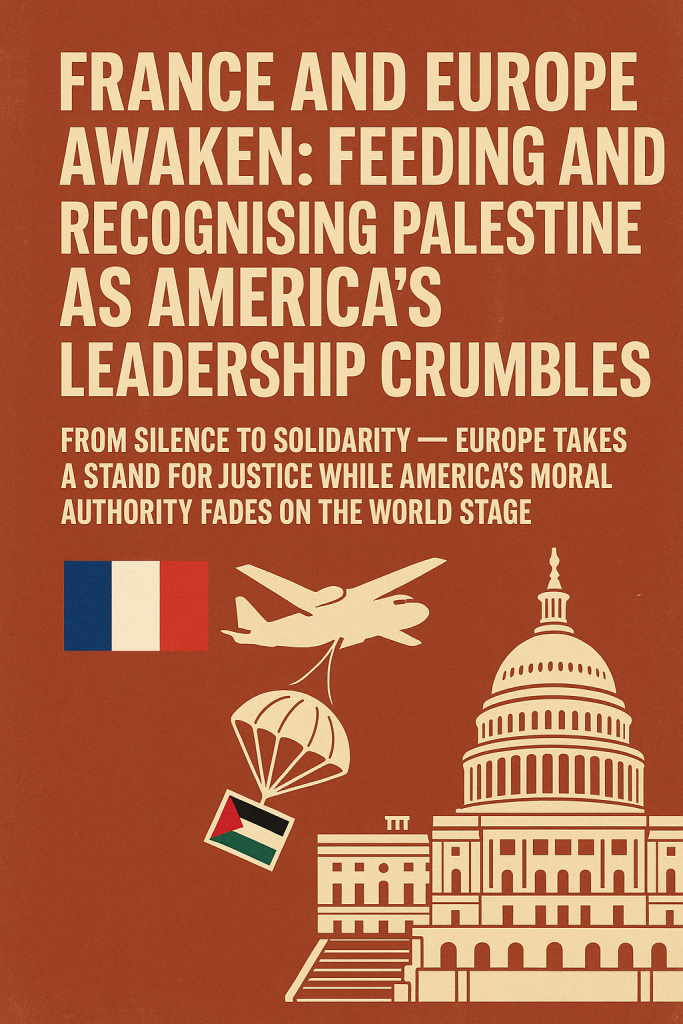
France and Europe Awaken: Feeding and Recognising Palestine as America’s Leadership Crumbles
Aug
From silence to solidarity — Europe takes a stand for justice while America’s moral authority fades on the world stage.
There are moments in history when the silence of nations becomes deafening — when injustice festers not just because of aggression, but because of apathy. For decades, the issue of Palestinian statehood and the plight of Gaza’s people have been pushed to the margins of international politics. But something is shifting. A new momentum is rising across Europe, and France — long seen as a diplomatic power with deep ties in both the West and the Global South — is now stepping into a leadership void left by the United States.
This week, France made two defining moves that sent a clear message to the world. First, they led with compassion — dropping food aid into Gaza, a region devastated by months of bombardment, blockade, and humanitarian collapse. Second, they moved politically — joining the rising European voices advocating for the formal recognition of the State of Palestine. These actions signal not just a shift in foreign policy, but a moral reawakening. In contrast, America, once the self-proclaimed “beacon of freedom and democracy,” continues to lose credibility and moral authority on the global stage.
🇫🇷 France Leads Where Others Have Faltered
France’s delivery of food aid was not merely a logistical gesture — it was a symbolic one. At a time when Gaza is facing famine-like conditions, the act of sending food instead of weapons speaks volumes. It reflects a growing frustration within parts of Europe over the double standards and inaction surrounding the ongoing conflict in the Middle East.
Even more powerful was France’s push, alongside countries like Ireland, Spain, and Norway, toward the formal recognition of a Palestinian state. This move is not without risk — geopolitically, diplomatically, and economically. But it is a calculated risk rooted in justice, not political expediency.
By leading this charge, France is not only reaffirming its historic role as a moral and cultural force in international politics, but also forcing a long-overdue conversation about Palestinian sovereignty and self-determination.
🌍 A New European Momentum
France’s bold actions are part of a broader awakening within Europe. For years, European nations tiptoed around the Palestinian issue, often aligning with American foreign policy or remaining neutral for fear of disrupting the status quo. But today, we are witnessing a shift. Public opinion across Europe has grown increasingly critical of Israel’s disproportionate military responses and human rights violations, especially in Gaza. Civil society, student movements, churches, and even some mainstream media have begun to challenge the long-held narratives that dehumanize Palestinian resistance and obscure the realities of occupation.
Countries like Ireland and Spain have already voiced their support for a two-state solution with genuine commitment, not just rhetoric. Norway, often seen as a quiet mediator in international diplomacy, has also taken a stand. Now with France joining, a powerful European bloc is forming — one that may force the international community to reckon with the realities on the ground.
The European Union as a whole is being called to account. If this momentum continues, it could lead to formal EU-wide recognition of Palestine, sanctions on illegal settlements, and a dramatic reshaping of Western policy toward the region.
🇺🇸 America’s Moral Decline
In stark contrast to Europe’s awakening, the United States — once a global symbol of justice and leadership — now finds itself increasingly isolated and morally compromised.
Washington continues to fund and arm Israel’s military operations, even as reports of civilian massacres, bombed hospitals, and widespread displacement flood the media. The Biden administration’s muted responses and empty calls for “restraint” ring hollow, especially in light of its unwavering financial and diplomatic support for the Israeli government.
At the United Nations, America has consistently used its veto power to block resolutions demanding ceasefires or humanitarian access to Gaza. These actions have not gone unnoticed. Around the world, nations are beginning to question whether the U.S. still has the moral standing to speak on human rights, democracy, or international law.
The crumbling of America’s moral authority is not just an international issue — it has deep consequences at home. Domestically, Americans are more divided than ever on foreign policy, with younger generations and minority communities increasingly critical of U.S. complicity in international injustice. Protests on university campuses and in cities across the nation show that even within its own borders, the American government is losing the trust of its people.
🤝 Silence Is No Longer an Option
The silence of the international community has for too long enabled the suffering in Palestine to continue. But now, that silence is being shattered. France’s leadership — both in humanitarian aid and political recognition — is a clarion call to the rest of the world: you can no longer remain neutral in the face of genocide, occupation, and apartheid.
Recognition of Palestine is not an attack on Israel — it is a recognition of human dignity, self-determination, and the rights of a people who have lived stateless and under siege for over 75 years.
Every food parcel dropped over Gaza, every parliamentary vote in favor of Palestinian statehood, and every leader who speaks up — chips away at the machinery of oppression and plants seeds for a just future.
🕊️ The Road Ahead
Make no mistake: the road to peace is long, and recognition alone will not end the occupation or restore the lives already lost. But recognition is a start. It shifts the balance of diplomacy. It challenges the monopoly of narrative. It reminds the world that Palestinians are not just headlines — they are human beings with a homeland, history, and hope.
France and its allies have taken a bold first step. Now it’s time for others to follow — not just with words, but with action.
The moral vacuum left by the United States can either become a permanent void or an invitation for new leadership to rise. Europe, with its colonial past and modern global influence, has a responsibility — and now, perhaps, a calling — to rewrite its role in the story of Palestine.
✍️ Final Reflection
We are living in a historic moment — one that will be remembered not just by diplomats, but by generations of Palestinians and Israelis alike. The question is no longer whether Palestine should be recognised — the question is, how long will the world wait before justice is finally served?
Let it be said of this generation: we did not look away.
Let it be said of France and its European allies: they chose compassion over complicity, and courage over convenience.
And let it be said of the world: justice, at last, began to speak.
