
UK After Brexit: Sovereignty Secured or Economy Endangered? (Part 3 of 5)
Feb
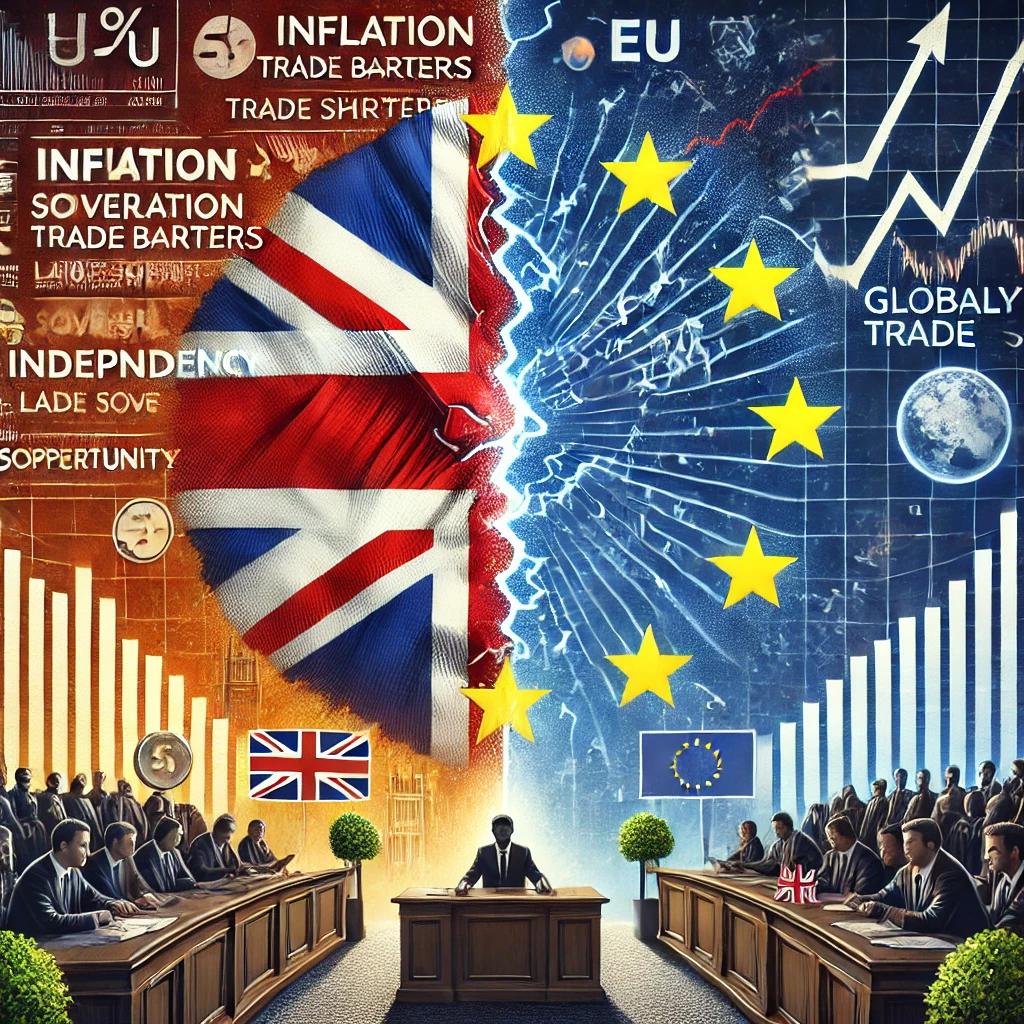
Part 3: The Economic Fallout – Growth or Decline?
Brexit was framed as an opportunity for Britain to break free from the constraints of EU bureaucracy, establish its own trade deals, and strengthen its economy through self-determination. However, since the UK formally left the European Union, the economic realities of this decision have become increasingly clear.
This article explores the economic fallout of Brexit, evaluating trade performance, inflation, business struggles, investment trends, and the financial sector. Has Brexit truly boosted the UK economy, or has it led to decline and stagnation?
The UK’s Trade Performance: A Brexit Boom or Slump?
Trade was one of the most debated topics during the Brexit campaign. Proponents argued that leaving the EU would free Britain to negotiate better trade deals worldwide, while critics warned of potential disruptions due to new trade barriers with the EU, the UK’s largest trading partner.
Trade with the EU: A Costly Separation
Despite the UK signing a Trade and Cooperation Agreement (TCA) with the EU, which allowed tariff-free trade, new non-tariff barriers have created significant hurdles:
- Increased Red Tape: British businesses now face customs declarations, regulatory checks, and border delays, increasing costs and reducing efficiency.
- Export Declines: The Office for Budget Responsibility (OBR) estimates that UK trade will be 15% lower in the long run compared to pre-Brexit trends.
- Small Business Struggles: Many small and medium-sized enterprises (SMEs) that relied on EU trade have been forced to downsize operations or stop trading with the bloc altogether.
Trade Outside the EU: New Deals, Limited Impact
Since Brexit, the UK has pursued independent trade agreements, securing deals with countries such as:
- Australia and New Zealand – Agreements signed, but projections show minimal economic growth.
- Japan – A largely similar deal to what the UK had under the EU framework.
- CPTPP (Comprehensive and Progressive Agreement for Trans-Pacific Partnership) – A significant step, but unlikely to compensate for lost EU trade.
Many economists argue that the UK’s new trade deals do not make up for the increased costs of trading with the EU. While the government highlights sovereignty in trade decisions, the immediate economic benefits remain unclear.
The Cost of Brexit: Inflation, Business Struggles, and Job Markets
While external global factors such as the COVID-19 pandemic and the Russia-Ukraine war have influenced inflation, Brexit has also contributed to rising costs through labor shortages, import taxes, and supply chain disruptions.
Inflation and Rising Costs
- The UK has experienced higher inflation rates compared to major economies like the US and EU.
- Increased import costs from the EU due to supply chain disruptions and trade barriers have driven up food prices.
- The fall in the value of the British pound post-Brexit has made imports more expensive.
Business Struggles and Industry Decline
Some industries have suffered disproportionately due to Brexit-related challenges:
- Manufacturing: Many UK manufacturers that depend on EU supply chains have faced higher costs and delivery delays.
- Automotive Sector: Companies such as Honda have closed UK plants, citing Brexit as a contributing factor.
- Agriculture and Fishing: British farmers have struggled with new export restrictions, while fishermen, promised a post-Brexit boost, have found it harder to sell seafood to EU markets.
Job Market Pressures
Brexit’s impact on labor availability has created workforce shortages in key industries:
- Healthcare: The NHS has struggled with reduced recruitment from EU nations.
- Hospitality and Agriculture: Worker shortages have led to operational struggles, as many EU workers left the UK.
- Skilled Labor: The new immigration system prioritizes skilled workers, but industries that relied on seasonal and lower-wage EU labor have been affected.
Although Brexit aimed to restructure the labor market to favor British workers, the reality has been economic friction, causing higher costs and labor shortages in key sectors.
Foreign Investment and Business Confidence: Are Companies Staying or Leaving?
One of the biggest uncertainties surrounding Brexit was how foreign companies would react to the UK’s departure from the EU single market. Would Britain remain an attractive destination for global investment, or would businesses relocate?
Foreign Direct Investment (FDI): A Declining Trend?
- The UK historically attracted large amounts of FDI, particularly in finance, technology, and automotive industries.
- However, since Brexit, investment growth has slowed, with businesses seeking more predictable environments within the EU.
- Major companies such as Panasonic and Sony have moved European headquarters from London to mainland Europe to maintain access to EU markets.
The Decline of London as a Business Hub?
While London remains a major financial center, Brexit has reduced its attractiveness for global firms:
- Some major financial institutions have shifted operations to Paris, Frankfurt, and Amsterdam to maintain access to EU financial markets.
- New job relocations—tens of thousands of banking jobs have moved out of London since Brexit.
- Uncertainty surrounding Brexit regulations has made businesses hesitant to expand UK operations.
Although the UK government has promoted new economic policies to attract investment, the combination of political instability, trade challenges, and EU market restrictions has dampened confidence.
Brexit and the Financial Sector: A Stronger City of London or a Shrinking Powerhouse?
The City of London, Europe’s financial hub, was expected to face post-Brexit challenges, as banks and financial institutions needed uninterrupted access to EU markets.
Financial Services and EU Access
- The UK lost passporting rights, which allowed financial firms to operate across the EU without additional regulatory approval.
- Many firms relocated assets to EU financial centers to ensure continued market access.
- The UK is seeking a more deregulated financial model, but uncertainty remains over whether it can maintain its competitive edge.
The Stock Market and Economic Performance
- While the London Stock Exchange remains influential, its dominance has been challenged by Amsterdam, Frankfurt, and Paris gaining larger shares of EU stock and derivatives trading.
- Despite government reassurances, long-term risks remain over the UK’s financial position on the global stage.
While Brexit has not resulted in an immediate collapse of the UK’s financial sector, the industry faces long-term challenges in maintaining its global influence.
Conclusion: Economic Growth or Stagnation?
Brexit was framed as an economic opportunity, but its impact has been mixed. While Britain has achieved trade sovereignty, economic consequences include higher costs, labor shortages, and trade disruptions.
Key takeaways:
✔ Sovereignty in trade and regulation has been achieved, but practical benefits remain limited.
❌ Trade with the EU has declined, and new global trade agreements have not compensated for lost market access.
❌ Businesses face increased costs, leading to closures and job losses in some sectors.
❌ Foreign investment has weakened, with some firms relocating or reducing UK operations.
❌ The City of London has lost some influence, but it remains a key financial hub.
A Mixed Economic Outlook
The UK’s post-Brexit economy faces uncertainty and structural shifts, with both challenges and opportunities. Sovereignty has been secured, but economic stability remains fragile.
The next part of this series will explore the social and workforce impact of Brexit, assessing whether immigration changes have improved or worsened the UK labor market.
🔹 Next Up: Part 4 – Immigration, Workforce, and Public Services: A New Reality?
Daniel Elijah Joseph is a lecturer in Accounting and Finance with a passion for Corporate Finance, a published author of self-help and spiritual books, and a dedicated blogger since 2017. With a deep interest in spirituality, love, and current affairs, he writes thought-provoking analyses that bridge economics, leadership, and faith. Through his newsletter, The Alchemy of Wisdom, he continues to explore the evolving complexities of finance, global affairs, and divine wisdom.
For more insights, visit DanielelijahJoseph.com.
