
When Bold Faith Changes the Atmosphere
Mar
Throughout history, certain individuals have carried a level of conviction that seemed to shift the spiritual atmosphere around them. Their confidence in divine truth was so strong that it inspired belief in others and created an environment where hope replaced despair. One such figure was John Alexander Dowie.
Dowie became known for his fearless proclamation that healing was part of God’s restorative work. At a time when many people accepted sickness and suffering as unavoidable realities, he introduced a radically different perspective: that faith could open the door for transformation.
What made Dowie’s ministry powerful was not merely the message he spoke but the boldness with which he spoke it. His confidence carried a kind of spiritual authority that drew attention across cities and nations. People travelled great distances to hear his teaching because his conviction awakened something within them — a renewed expectation that restoration was possible.
Faith has always had this unique effect. When someone truly believes in a higher reality, that belief can influence the environment around them. Hope becomes contagious. Courage begins to rise in places where fear once dominated. The presence of confident faith often inspires others to reconsider what they previously thought was impossible.
Dowie understood this dynamic deeply. His ministry emphasized the importance of aligning the heart, mind, and spirit with divine truth. For him, healing was not merely a physical phenomenon but a manifestation of spiritual alignment — an atmosphere where faith, expectation, and prayer intersected.
Many historical healing movements operated on this same principle. When communities gathered in prayer, when people believed that restoration was possible, and when spiritual leadership encouraged faith rather than despair, remarkable testimonies often followed. The atmosphere itself seemed to change.
Whether one interprets these events spiritually, psychologically, or socially, the pattern remains fascinating: belief shapes perception, and perception influences outcomes. When people expect restoration, they often begin to see possibilities where they previously saw limitations.
The idea that faith can influence reality has been explored for centuries across religious traditions. In the Christian tradition, faith has frequently been described as the bridge between hope and manifestation — the internal conviction that something unseen can become visible.
Dowie’s boldness reminds us of an important principle: courage in belief can shift the mindset of entire communities. When someone refuses to accept defeat as the final word, they open the door for a different narrative.
In today’s world, where uncertainty and anxiety often dominate public conversation, the message of spiritual confidence remains relevant. Faith does not deny difficulty, but it challenges the assumption that difficulty is permanent. It reminds people that restoration, healing, and renewal remain possible.
This perspective encourages individuals to approach life with expectation rather than resignation. When hope replaces despair, people become more resilient, more courageous, and more open to transformation.
The legacy of faith leaders like Dowie therefore extends beyond historical events. Their example demonstrates how belief, when anchored in purpose and conviction, can inspire change in individuals and communities alike.
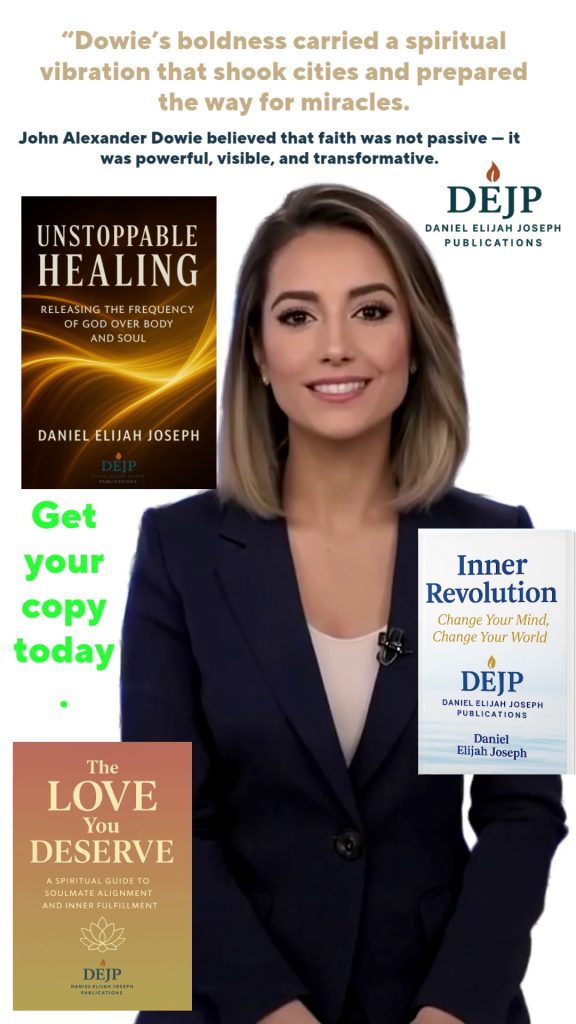
📘 Explore the deeper spiritual principles behind healing, faith, and divine alignment in
Unstoppable Healing: Releasing the Frequency of God Over Body and Soul by Daniel Elijah Joseph — available now on Amazon.
Get your copy today.
✨ For more reflections on healing and spiritual growth, visit
www.Danielelijahjoseph.com
